



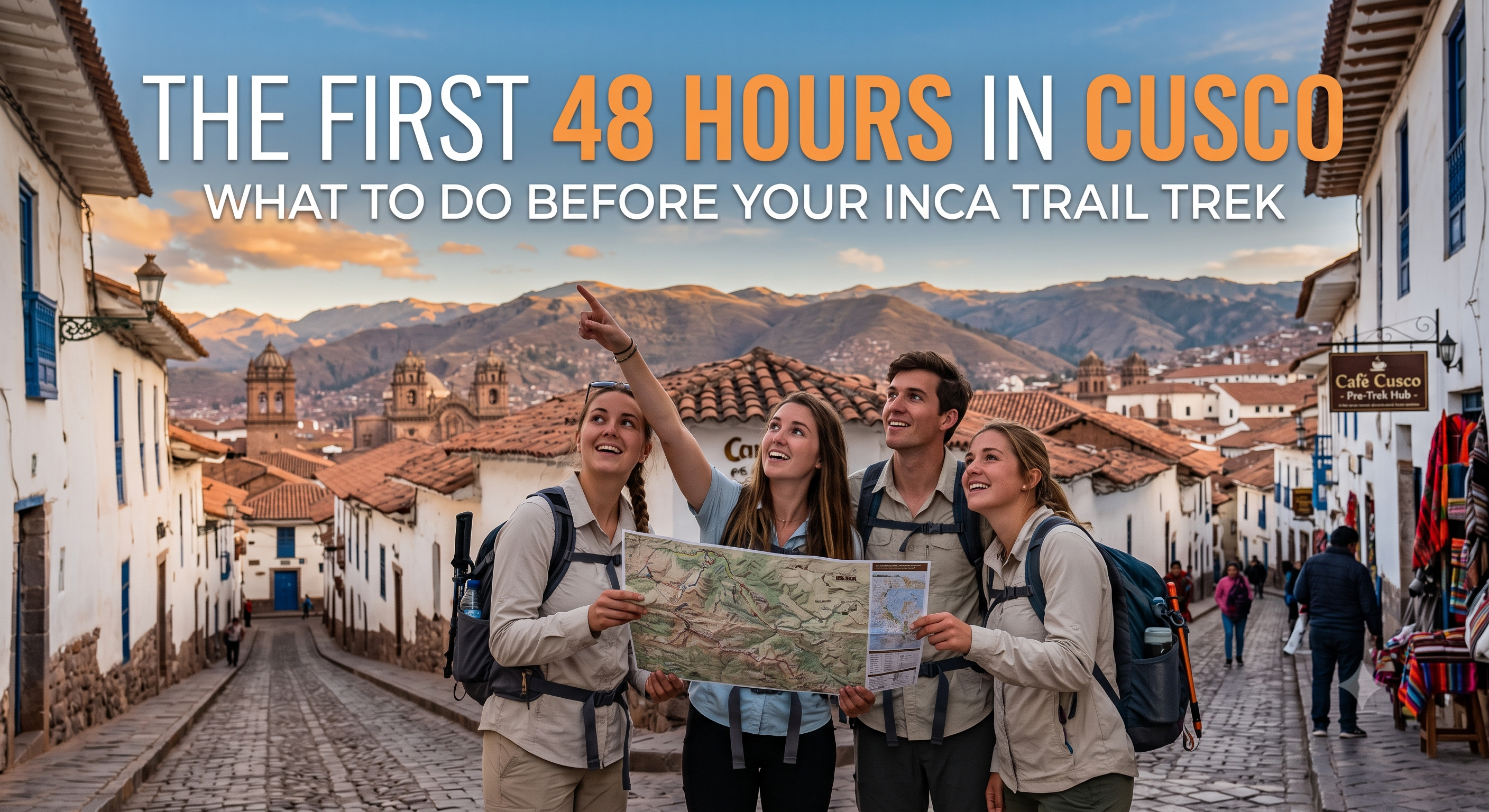
Your first 48 hours in Cusco should be devoted to acclimatizing, resting, hydrating normally, eating familiar meals, organizing your equipment, and monitoring how your body responds to the altitude. Avoid strenuous hikes, intense workouts, alcohol, late nights, and a packed sightseeing schedule. Instead, take short walks near your hotel, attend your Inca Trail Trek briefing, check your passport and equipment, and get two good nights of rest.
Cusco sits at approximately 3,399 meters, or 11,150 feet, above sea level. That is high enough for newly arrived travelers to experience headaches, tiredness, nausea, dizziness, reduced appetite, or disturbed sleep.
Arriving at least two days before your Inca Trail departure gives your body valuable time to begin adjusting before you hike to even higher elevations.
Key Takeaways for Your First 48 Hours in Cusco
- Keep physical activity light during your first two days.
- Avoid alcohol for at least the first 48 hours at altitude.
- Drink regularly, but do not force excessive amounts of water.
- Eat light, familiar, easy-to-digest meals.
- Take a short, gentle walk only if you feel well.
- Do not schedule Rainbow Mountain or another high-altitude hike immediately after arrival.
- Keep your original passport, medications, and essential equipment accessible.
- Attend your Alpaca Expeditions briefing and confirm the pickup arrangements for your trek.
- Tell your guide about dietary restrictions, medical concerns, or new symptoms.
- Do not continue to a higher sleeping altitude if you are experiencing symptoms of altitude sickness.
- Seek medical help for confusion, difficulty walking normally, breathing difficulty at rest, or rapidly worsening symptoms.
Why Are the First 48 Hours in Cusco So Important?
Many American travelers reach Cusco after traveling from cities close to sea level. They may fly from the United States to Lima, spend several hours at or near sea level, and then take a short domestic flight directly into the Andes.
The change happens quickly. In a little over an hour of flying from Lima, a traveler can arrive at a sleeping altitude of around 11,150 feet.
Your body therefore receives very little time to adjust gradually.
At higher elevations, atmospheric pressure is lower. Although the percentage of oxygen in the air remains approximately the same, each breath delivers fewer oxygen molecules to your body. In response, you begin breathing faster, your heart may work harder, and your kidneys initiate changes that support acclimatization.
This adaptation does not happen instantly. The early adjustment process takes place over hours and days, which is why your first two nights in Cusco matter.
The CDC recommends mild exercise only during the first 48 hours at altitude and advises travelers to avoid alcohol during that period. It also emphasizes that gradual ascent and added acclimatization time reduce the likelihood of acute mountain sickness.
Fitness Does Not Guarantee Protection
One of the most common misconceptions among Inca Trail hikers is that altitude sickness affects only unfit people.
That is not true.
Excellent cardiovascular fitness may help you manage steep stairs and long hiking days, but it does not make you immune to acute mountain sickness. A marathon runner can develop symptoms while a less athletic traveler feels relatively comfortable.
According to the CDC, physical fitness does not determine a person’s susceptibility to altitude illness. Previous experience at a similar altitude and a similar rate of ascent may offer some guidance, but even that cannot reliably predict how someone will feel on a future trip.
Do not treat your first afternoon in Cusco as a fitness test. Walking quickly uphill to prove that you are prepared can leave you unnecessarily exhausted before your trek has even begun.
The Inca Trail Climbs Higher Than Cusco
Cusco is not the highest point of your journey.
On the Classic Inca Trail, hikers climb to Dead Woman’s Pass, also known as Warmi Wañusqa, at approximately 4,215 meters or 13,829 feet. This is more than 2,600 feet higher than central Cusco.
The first 48 hours will not provide complete acclimatization to every elevation on the trail. However, they can help your body begin adapting and allow you to identify potential problems before entering a more remote environment.
Alpaca Expeditions recommends arriving in Peru at least two days before an Inca Trail trek when possible. The company also advises travelers to use this time for gentle activity, hydration, sleep, and final preparation.
A Practical 48-Hour Cusco Acclimatization Schedule
The following schedule is designed for a traveler arriving in Cusco approximately two days before an Inca Trail departure.
You do not need to follow each hour exactly. Flight times, hotel arrangements, trek briefings, and individual responses to altitude will vary. Use the plan as a flexible framework.
| Time after arrival | Main priority | Recommended activities | Activities to avoid |
| 0 – 2 hours | Settle in | Hotel transfer, check-in, water, light snack | Rushing, carrying heavy luggage upstairs |
| 2 – 6 hours | Rest and observe | Relax, light meal, short walk near hotel | Long city tour, steep hills, intense exercise |
| 6 – 12 hours | Recover from travel | Early dinner, organize essentials, early bedtime | Alcohol, heavy dinner, nightlife |
| 12 – 24 hours | Complete first night | Sleep, slow morning, symptom check | Early high-altitude excursion |
| 24 – 30 hours | Gentle movement | Breakfast and easy walk | Running, gym workout, steep hike |
| 30 – 36 hours | Practical preparation | Equipment review, purchases, relaxed sightseeing | Overpacked itinerary |
| 36 – 42 hours | Trek coordination | Briefing, guide questions, duffel organization | Ignoring symptoms to protect plans |
| 42 – 48 hours | Final recovery | Early dinner, shower, sleep | Last-minute partying or repacking all night |
Hours 0 – 2: Arrive, Check In, and Slow Down
The excitement of landing in Cusco can make you want to begin exploring immediately. Resist that temptation for the first couple of hours.
Your priorities should be simple:
- Transfer to your accommodation.
- Check in and locate your room.
- Drink a moderate amount of water.
- Eat a small snack if you are hungry.
- Sit or lie down for a short rest.
- Pay attention to how you feel.
You may notice that walking up a staircase or carrying luggage requires more effort than expected. That alone does not necessarily indicate altitude sickness. Exercise capacity is reduced at altitude, including in healthy, acclimatizing travelers.
Let hotel staff or your driver assist with large suitcases when possible. There is no benefit in carrying a heavy bag up several flights of stairs immediately after arrival.
Keep Essential Items Accessible
Before you rest, identify where you placed:
- Your original passport
- Travel insurance information
- Personal prescriptions
- Emergency contact details
- Alpaca Expeditions booking information
- Your phone and charger
- A water bottle
- Any medication prescribed by your healthcare professional
- Your hotel address
Do not place your passport or essential medication at the bottom of a suitcase that will later be stored elsewhere.
Hours 2 – 6: Rest First, Then Consider a Short Walk
After checking in, allow yourself time to recover from the flight and the rapid elevation change.
A short nap may help if you are exhausted, although a long afternoon sleep can make it harder to rest during the night. Try lying down, reading, organizing a few belongings, or simply relaxing for an hour.
If you feel reasonably well, take a short and gentle walk close to your accommodation.
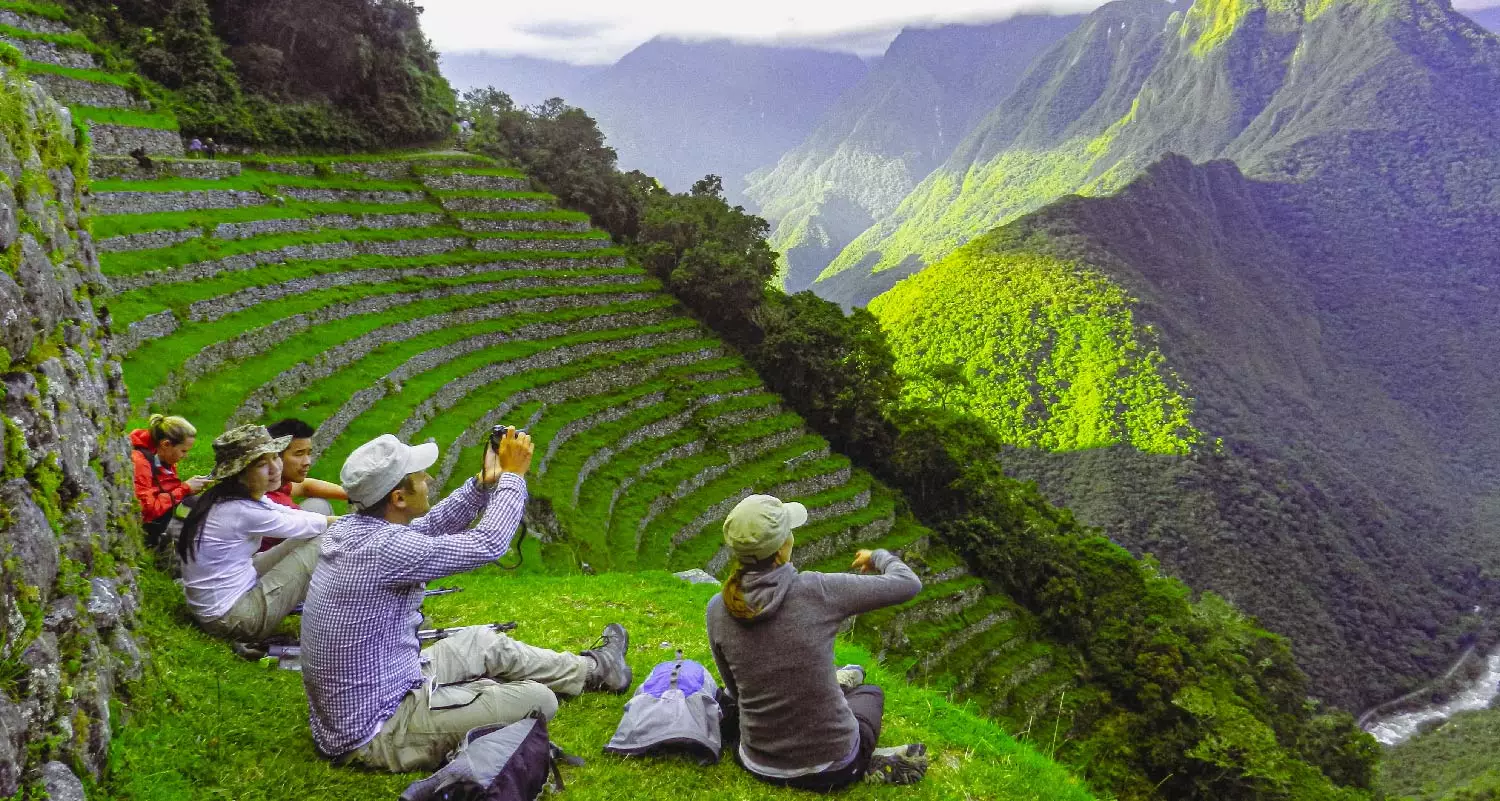
The purpose is not to complete a sightseeing itinerary. The purpose is to move lightly, become familiar with your surroundings, and evaluate how your body responds.
Good first-day options may include:
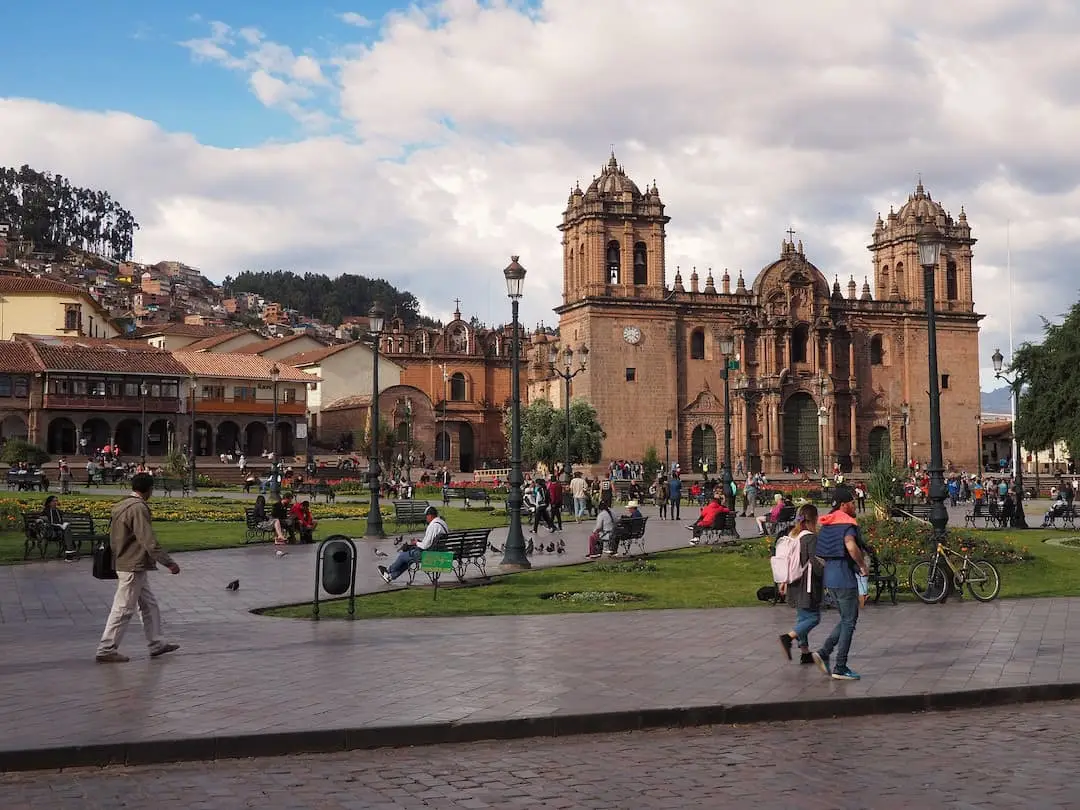
- Sitting in or near the Plaza de Armas
- Walking one or two quiet blocks around your hotel
- Visiting a nearby café
- Buying bottled water or small supplies
- Eating at a restaurant within easy walking distance
- Exploring a mostly level section of the historic center
Cusco’s official tourism information places the historic center at more than 3,300 meters above sea level. Even an ordinary city walk is therefore an activity at significant altitude.
Turn Around Before You Feel Tired
Do not wait until you feel completely exhausted before returning to the hotel.
A useful first-day rule is to finish your walk while you still feel comfortable. Walk slowly, take breaks, and avoid racing up Cusco’s steep streets.
San Blas is beautiful, but its slopes and stairways can feel demanding immediately after arrival. Sacsayhuamán also involves higher ground and more walking than many visitors expect. Save longer explorations for your second day or for a later trip, particularly if you are experiencing a headache, dizziness, or nausea.
Hours 6 – 12: Eat Early, Skip Alcohol, and Prepare for Sleep
Your first evening should be deliberately quiet.
Have dinner early enough that you can digest your meal before going to bed. Select something familiar and moderately sized rather than treating your arrival night as an opportunity for a large tasting menu.

A simple meal may include:
- Soup
- Rice or potatoes
- Cooked vegetables
- Chicken, fish, eggs, or another familiar protein
- Bread or crackers
- Pasta
- A mild quinoa dish
- Fruit that has been washed and prepared safely
There is no single “altitude diet” that guarantees protection from mountain sickness. The goal is to eat enough to support recovery without choosing a meal that worsens nausea, reflux, or stomach discomfort.
Avoid Alcohol During the First 48 Hours
Skip the celebratory pisco sour on your first and second nights.
The CDC specifically advises avoiding alcohol during the first 48 hours at high altitude. Alcohol can interfere with sleep, impair judgment, and make it harder to distinguish an ordinary hangover from symptoms of acute mountain sickness. Respiratory depressants should not be used as sleep aids at altitude.
Cusco’s restaurants and nightlife will still be there after your trek.
Can You Drink Coffee?
You do not necessarily need to stop drinking coffee.
The CDC recommends that regular caffeine users continue their normal intake so that caffeine-withdrawal headaches are not confused with altitude-related headaches.
Keep your intake moderate. Your first day is not the best time for several large coffees or high-caffeine energy drinks, particularly if they make you anxious, disturb your sleep, or upset your stomach.
Expect Your First Night to Feel Different
Sleep disturbance is common at high altitude. Some travelers wake frequently, have vivid dreams, breathe irregularly during sleep, or feel as though they did not rest deeply.
Periodic breathing becomes common above approximately 2,700 meters, and sleep often improves as acclimatization progresses. Poor sleep by itself does not always mean that you have acute mountain sickness.
However, poor sleep accompanied by a worsening headache, repeated vomiting, confusion, severe weakness, or breathing difficulty requires more attention.
Hours 12 – 24: Complete Your First Night and Check Your Symptoms
When you wake up, do not immediately jump out of bed and begin packing for an excursion.
Sit up slowly and assess yourself.
Ask:
- Do I have a headache?
- Do I feel nauseated?
- Am I unusually dizzy?
- Can I walk normally?
- Am I short of breath while resting?
- Is my condition better, unchanged, or worse than last night?
- Can I eat and drink normally?
- Do I feel alert and mentally clear?
Symptoms of acute mountain sickness often begin between two and 12 hours after arriving at a new altitude, frequently during or after the first night. Headache is the most characteristic symptom and may occur with nausea, loss of appetite, dizziness, tiredness, or vomiting.
A mild headache does not automatically mean that your trek is over. It does mean that you should take the symptom seriously, remain at the same or a lower altitude, rest, and monitor for improvement or progression.
Do not hide symptoms because you are afraid of missing your hike.
Hours 24 – 30: Start Day Two Slowly
If you wake feeling well, begin with breakfast and a gentle morning.
Eat something familiar, such as:
- Eggs
- Oatmeal
- Bread or toast
- Yogurt, if you normally tolerate it
- Fruit
- Pancakes
- Quinoa porridge
- A modest amount of coffee or tea
Continue drinking fluids normally.
You may feel tempted to test your legs with an intense stair workout or early run. Do not. The CDC recommends only mild exercise during the first 48 hours at altitude.
A 20- to 45-minute easy walk is more appropriate than a hard training session.
A Gentle Day-Two Walking Plan
A comfortable plan could include:
- Walk slowly to the Plaza de Armas.
- Sit for 15 to 20 minutes.
- Visit one nearby attraction or café.
- Return to your hotel before lunch.
- Rest for at least an hour.
- Reassess how you feel.
You are not trying to gain fitness. Fitness improvements require weeks or months. The purpose of gentle movement is to remain mobile without creating unnecessary fatigue.
Hours 30 – 36: Complete Your Equipment and Administrative Checks
The middle of your second day is a good time to organize your trek.
You should already have most of your equipment, but Cusco has shops where travelers can purchase forgotten items. Prioritize essential equipment rather than buying unnecessary accessories.
Passport and Document Checklist
Confirm that you have:
- Your original passport
- The passport used when your Inca Trail permit was booked
- A valid student identification card, when applicable
- Travel insurance information
- Emergency contact details
- Copies or secure digital backups of important documents
- Booking confirmation
- Hotel pickup information
- Any required balance-payment confirmation
The physical passport is required at Inca Trail checkpoints. Alpaca Expeditions advises hikers to keep the original document available rather than relying on a photocopy.
If your passport was renewed or changed after booking, contact the Alpaca Expeditions team before the trek instead of waiting until the morning of departure.
Personal Equipment Checklist
Review the requirements for your specific itinerary. A Classic Inca Trail trek and a Short Inca Trail itinerary do not always have identical luggage arrangements.
Common essentials include:
- Broken-in hiking boots or trail shoes
- Hiking socks
- Moisture-wicking shirts
- Hiking pants
- Warm base or mid-layers
- Insulated jacket
- Waterproof jacket or poncho
- Sun hat
- Warm hat and gloves
- Sunscreen
- Sunglasses
- Insect repellent
- Reusable water bottle or hydration reservoir
- Headlamp
- Personal medication
- Small personal first-aid items
- Blister treatment
- Toiletries
- Portable battery pack
- Cash in small denominations
- Daypack with a rain cover
- Trekking poles, when preferred
- Sleeping equipment when required by your package
Alpaca Expeditions publishes a trek packing list that covers differences between daypacks, duffel bags, trekking clothing, wet-season equipment, passports, sun protection, and personal medication.
Do Not Wear New Hiking Boots
New footwear should not be broken in on the Inca Trail.
Even a well-reviewed boot can create blisters if the shape does not suit your foot. Use footwear that you have already worn on long walks, hills, or training hikes.
If you discover a footwear problem in Cusco, seek advice early enough to test any replacement before the trek.
Organize Your Daypack Separately
Your daypack should contain everything you may need while walking, because you may not have access to your main duffel until camp or your hotel.
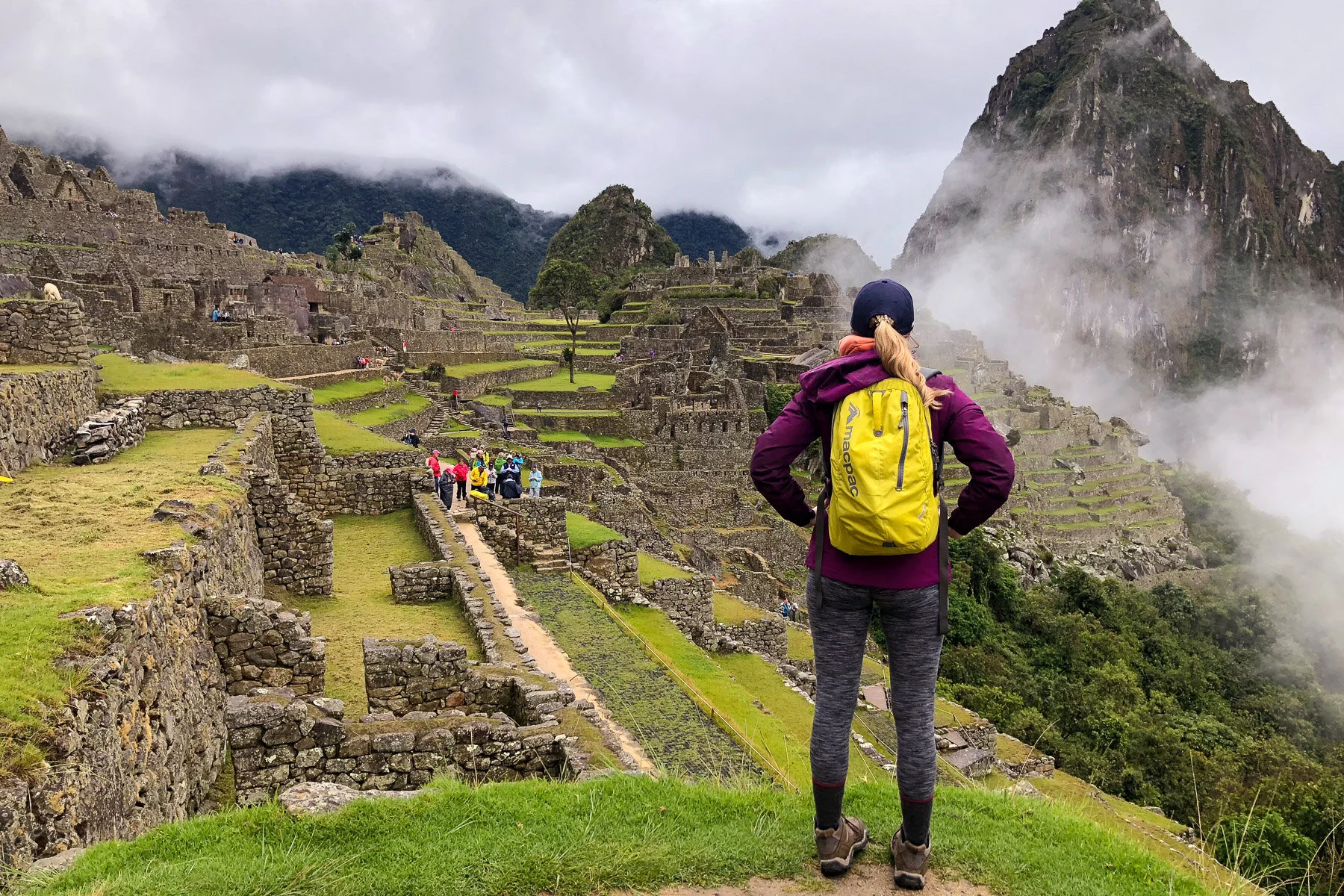
Keep these items in your daypack:
- Passport
- Water
- Snacks
- Sunscreen
- Rain protection
- Warm layer
- Personal medication
- Inhaler or other essential medical device
- Phone or camera
- Portable charger
- Hand sanitizer
- Toilet paper or tissues
- Blister care
- A small amount of cash
Do not place time-sensitive medication or your original passport in the porter-carried duffel.
Hours 36 – 42: Attend Your Pre-Trek Briefing
Your briefing is one of the most important parts of your final preparation.
Alpaca Expeditions generally conducts pre-trek briefings at its Cusco office on the evening before camping treks. During the meeting, travelers meet their guide, review the itinerary, ask last-minute questions, confirm pickup details, and receive a duffel bag when one is included. Briefing times and baggage arrangements can vary by itinerary, so follow the information in your reservation rather than assuming every trek has the same schedule.
Questions to Ask Your Guide
Use the briefing to ask:
- What is my confirmed hotel pickup time?
- Where should I wait for the vehicle?
- What is the duffel weight limit for my specific trek?
- Is my sleeping bag or mattress included in that weight?
- How much water should I carry at the start?
- When will drinking water be available?
- What should remain in my daypack?
- What weather is expected?
- Are trekking poles recommended for the current conditions?
- Where can I store the luggage I am not taking?
- What happens if I feel unwell before pickup?
- Who should I contact overnight?
- Have my dietary restrictions been recorded?
- Does the guide know about my relevant medical history?
- What is the procedure if symptoms develop on the trail?
Tell your guide about food allergies, prescription medication, asthma, diabetes, a history of altitude illness, recent injury, or any symptom you are currently experiencing.
A guide cannot support a condition that has not been disclosed.
Follow the Correct Duffel Limit
Duffel limits can differ among itineraries.
Some Classic Inca Trail services allow a duffel weighing up to approximately 7 kilograms, including designated sleeping equipment. Certain shorter itineraries may use different limits and luggage transportation arrangements. Check the current instructions for your booked tour.
Weigh or carefully review your duffel before bedtime. Do not leave this task until the pickup vehicle is outside.
Hours 42 – 48: Eat, Pack, and Go to Bed Early
After your briefing, return to your hotel and complete the final packing process.
Lay out your hiking clothes for the morning. Charge your phone, camera, and portable battery. Set more than one alarm if necessary.
Place the following together:
- Passport
- Wallet
- Phone
- Water bottle
- Daypack
- Hiking shoes
- Trekking poles
- Duffel bag
- Medication
- Rain jacket
- Breakfast or snack if your pickup is extremely early
Eat an early dinner and avoid experimenting with an unusually rich, spicy, or unfamiliar meal.
Your final evening should not become a stressful repacking marathon. Stop checking equipment at a reasonable hour and sleep.
How Much Water Should You Drink in Cusco?
Drink regularly enough to avoid dehydration, particularly after air travel and in Cusco’s dry mountain environment. However, do not force yourself to consume excessive amounts of water.

Overhydration has not been shown to prevent altitude illness and can increase the risk of dangerously low blood sodium. Maintaining normal hydration is useful because dehydration symptoms can resemble acute mountain sickness, but drinking gallons of water is not a treatment for altitude exposure.
A practical approach is to:
- Sip fluids regularly.
- Drink with meals.
- Carry a reusable bottle.
- Drink more when you are thirsty.
- Watch for very dark urine, dry mouth, or other signs of dehydration.
- Avoid trying to reach an arbitrary extreme water target.
- Replace fluids gradually if you have been vomiting or experiencing diarrhea.
Water does not replace acclimatization, rest, medical evaluation, oxygen when clinically required, or descent in a serious emergency.
Does Coca Tea Prevent Altitude Sickness?
Coca tea is part of Andean culture and is commonly offered to visitors in Cusco. Some travelers find the warm drink comforting, particularly when they feel cold or mildly nauseated.
However, coca tea should not be treated as a medically proven substitute for acclimatization or appropriate care.
It cannot guarantee protection from acute mountain sickness, and it should never delay medical evaluation, oxygen, or descent when dangerous symptoms are present.
Travelers should also remember that coca products can potentially affect drug-testing results. Anyone subject to workplace, military, athletic, or legal drug testing should consider avoiding coca products before returning home.
What Symptoms Are Normal, and Which Are Dangerous?
Altitude symptoms exist on a spectrum. The most important skill is recognizing when mild discomfort is progressing into something more serious.
| Symptom | Possible meaning | Recommended response |
| Mild shortness of breath while climbing stairs | Common reduced exercise capacity at altitude | Slow down, rest and monitor |
| Mild fatigue | Travel exhaustion or acclimatization | Rest, eat and limit activity |
| Poor sleep | Common at altitude | Maintain a quiet schedule and monitor other symptoms |
| Headache with nausea or dizziness | Possible acute mountain sickness | Stop ascending, rest and tell someone |
| Repeated vomiting | More concerning altitude illness or another medical problem | Seek medical advice |
| Worsening headache despite rest | Illness may be progressing | Obtain medical assistance |
| Difficulty walking in a straight line | Possible high-altitude cerebral edema | Emergency response and descent |
| Confusion or unusual drowsiness | Possible high-altitude cerebral edema | Emergency medical help |
| Shortness of breath at rest | Possible high-altitude pulmonary edema or another emergency | Urgent medical help and descent |
| Chest congestion or worsening cough | Possible pulmonary problem | Immediate evaluation |
| Rapid decline in exercise ability | Possible high-altitude pulmonary edema | Stop activity and seek help |
Mild Acute Mountain Sickness
Acute mountain sickness commonly presents with a headache accompanied by one or more symptoms such as:
- Nausea
- Dizziness
- Loss of appetite
- Fatigue
- Vomiting
- General weakness
Symptoms often begin within two to 12 hours of arrival or after moving to a higher altitude. Mild cases may improve over 12 to 48 hours when the traveler does not ascend farther.
High-Altitude Cerebral Edema
High-altitude cerebral edema, or HACE, affects the brain and is a medical emergency.
Warning signs include:
- Confusion
- Altered behavior
- Extreme drowsiness
- Difficulty walking normally
- Staggering or loss of coordination
- Reduced consciousness
Suspected HACE requires urgent descent and medical treatment. Waiting to see whether it improves overnight can be dangerous.
High-Altitude Pulmonary Edema
High-altitude pulmonary edema, or HAPE, affects the lungs.
Early symptoms can include:
- Unusual reduction in hiking ability
- Chest congestion
- Cough
- Shortness of breath that is excessive for the activity
More advanced symptoms include breathing difficulty at rest and severe respiratory distress. Descent is urgent in most field situations, and oxygen should be used when available under appropriate supervision.
What Should You Do If You Feel Sick Before the Trek?
Tell your travel companion, hotel staff, guide, or Alpaca Expeditions contact that you are unwell.
Do not keep symptoms private because you are worried that someone will cancel your trek.
Follow these principles:
- Do not ascend to a higher sleeping altitude while symptomatic.
- Rest at your current altitude when symptoms are mild.
- Seek medical advice when symptoms are moderate, persistent, unusual, or worsening.
- Descend when symptoms worsen despite rest or treatment.
- Treat confusion, walking difficulty, or breathlessness at rest as an emergency.
The CDC emphasizes three essential rules: recognize early symptoms, never ascend to sleep higher while experiencing altitude illness, and descend if symptoms worsen at the same elevation.
Your health is more important than maintaining a fixed itinerary.
Should You Take Altitude Medication During Your First 48 Hours?
Some travelers receive acetazolamide or another medication from a healthcare professional before traveling. The decision depends on factors such as:
- Planned rate of ascent
- Sleeping altitude
- Previous altitude illness
- Medical history
- Allergies
- Current prescriptions
- Kidney or lung conditions
- Pregnancy
- Individual risk factors
Do not begin prescription medication simply because another traveler offers you a tablet.

Acetazolamide can support acclimatization and may be recommended for some travelers, particularly when abrupt ascent is unavoidable. It is not appropriate to provide a universal recommendation for every visitor to Cusco. Discuss timing, suitability, side effects, and interactions with a qualified healthcare professional before travel.
Medication does not give you permission to ignore symptoms or continue ascending while becoming progressively unwell.
What Activities Should You Avoid Before the Inca Trail?
Rainbow Mountain
Do not use your first or second day in Cusco for Rainbow Mountain.
Rainbow Mountain excursions reach much higher elevations than Cusco. Even if the walking distance appears manageable, the altitude can place additional stress on a traveler who has only just arrived.
Save it for later in your Peru itinerary, after you have acclimatized and completed your primary trek.
Hard Gym Sessions
A final high-intensity workout will not improve your Inca Trail fitness. It is more likely to leave you sore, dehydrated, or injured.
Your training work should have been completed before traveling.
Long, Steep City Walks
Cusco’s streets can involve slopes, stone steps, and uneven cobblestones. A route that looks short on a map may require more effort than expected.
Keep the first day especially easy.
Large Amounts of Alcohol
Alcohol may interfere with sleep and judgment while making symptom assessment more difficult. Avoid it during the first 48 hours.
Unfamiliar Food Challenges
Cusco has an excellent food scene, but the night before a multiday trek is not an ideal time to discover that a very rich or unfamiliar dish does not agree with you.
Late-Night Socializing
The Inca Trail often begins with an early hotel pickup. Protect your sleep instead of staying out late.
Common First-48-Hour Mistakes
Mistake 1: Scheduling Every Major Cusco Attraction
Your acclimatization period should not feel like a race through a checklist.
Choose one or two gentle activities and leave space for rest.
Mistake 2: Assuming a Headache Is Only Jet Lag
A headache could come from travel fatigue, caffeine withdrawal, dehydration, or altitude. Do not automatically dismiss it.
Monitor whether it improves, remains stable, or worsens.
Mistake 3: Drinking Excessive Water
Normal hydration is important. Forced overhydration is not an altitude-sickness prevention strategy.
Mistake 4: Hiding Symptoms From the Guide
Guides need accurate information to make responsible decisions. Describe your symptoms honestly at the briefing.
Mistake 5: Packing Essential Medication in the Duffel
Keep medication you may need during the day in your personal daypack.
Mistake 6: Forgetting the Original Passport
An image or photocopy may be useful as a backup, but it does not replace the original passport required at checkpoints.
Mistake 7: Wearing Unused Equipment
New boots, socks, rain jackets, and daypacks can create unexpected problems. Test them before traveling whenever possible.
Mistake 8: Believing Two Days Guarantee Full Acclimatization
Forty-eight hours can help significantly, but every person adapts differently. You must continue monitoring yourself throughout the trek.
Is It Better to Stay in the Sacred Valley First?
The Sacred Valley contains towns at lower elevations than central Cusco. For some travelers flying directly from sea level, sleeping at a lower altitude for one or two nights may offer a more gradual transition.
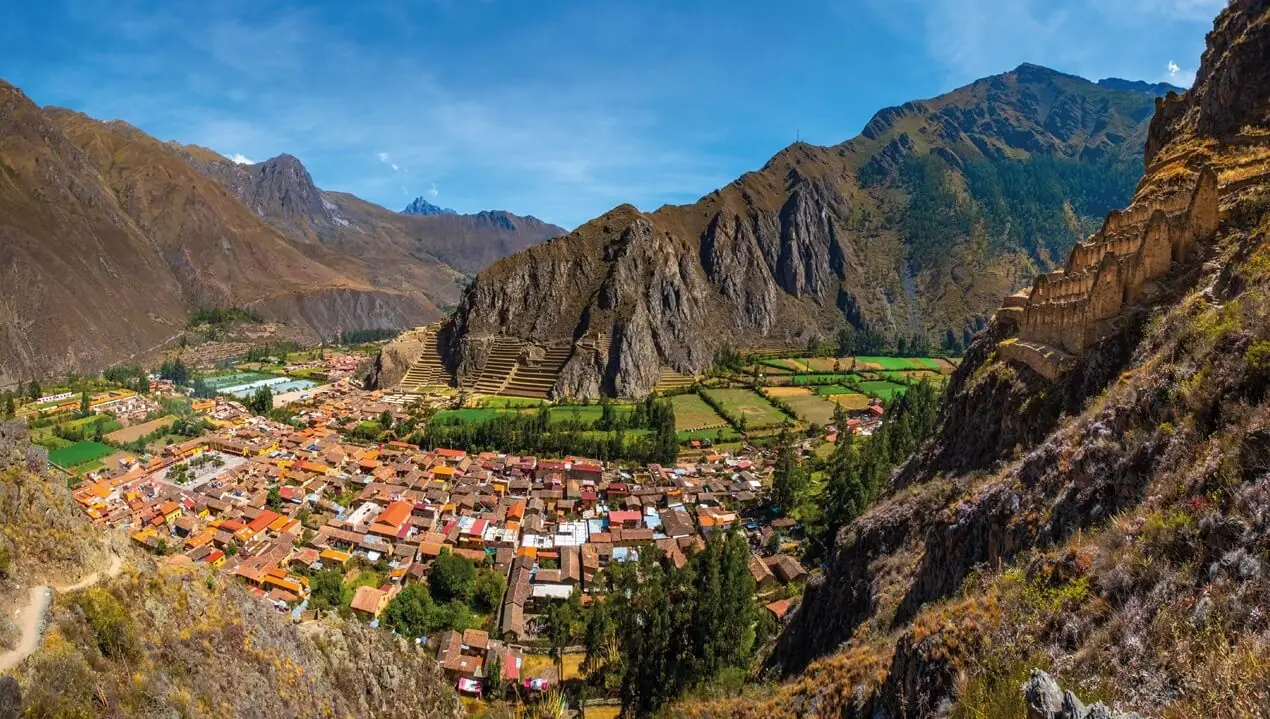
The CDC specifically notes that travelers arriving in places such as Cusco may be able to descend below the airport’s elevation to sleep before beginning a higher ascent.
However, the best arrangement depends on:
- Your trek’s starting point
- Your briefing location
- Transportation times
- Hotel booking
- Arrival hour
- Medical considerations
- Whether you need to return to Cusco before departure
Do not change your accommodation at the last minute without checking your trek logistics. Alpaca Expeditions briefings generally take place in Cusco, and pickup arrangements should be confirmed for your specific hotel and route.
The Final Night Checklist
Before sleeping, confirm each item:
Health
- I can eat and drink.
- I can walk normally.
- I am not confused.
- I do not have shortness of breath at rest.
- My symptoms are absent, mild and improving, or have been medically evaluated.
- My guide knows about relevant medical issues.
Documents
- Original passport
- Student card when applicable
- Insurance details
- Booking information
- Emergency contacts
Daypack
- Water
- Snacks
- Rain jacket
- Warm layer
- Sunscreen
- Sun hat
- Personal medication
- Passport
- Phone
- Charger
- Cash
- Blister care
Duffel
- Correct weight
- Camp clothing
- Sleeping equipment when required
- Toiletries
- Items not needed while hiking
Departure
- Pickup time confirmed
- Hotel address confirmed
- Alarm set
- Phone charged
- Hiking clothes ready
- Breakfast arrangements confirmed
Preparing With Alpaca Expeditions
A successful Inca Trail experience begins before you reach the trailhead.
Alpaca Expeditions advises travelers to arrive early, spend time acclimatizing, check their equipment, prioritize sleep, and attend the scheduled briefing for their itinerary. The briefing allows you to meet your guide, discuss symptoms or concerns, confirm luggage limits, and understand the next morning’s pickup.
Use the first 48 hours to communicate openly with the team. Mention dietary restrictions, relevant health conditions, medications, recent injuries, or anything that may affect your ability to hike.
Being honest does not make you a difficult traveler. It helps the trekking team prepare responsibly.
Final Thoughts: Make Your First 48 Hours Part of the Trek
Your Inca Trail adventure does not begin at Kilometer 82. It begins when you arrive in Cusco and decide how to spend your first two days.
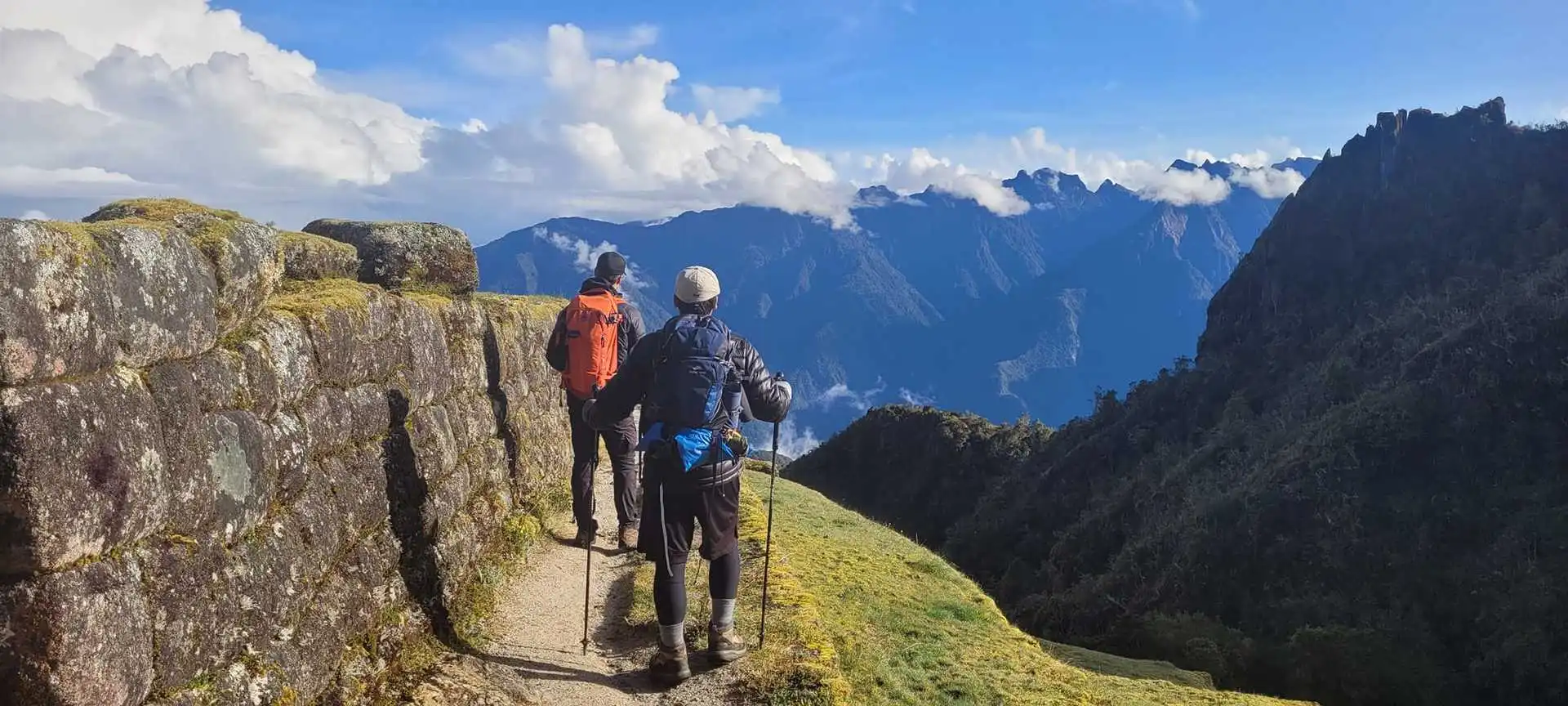
The smartest approach is straightforward: rest, move gently, drink normally, avoid alcohol, eat familiar meals, monitor symptoms, attend your briefing, organize your equipment, and sleep early.
Do not worry if stairs feel harder or if your normal walking pace slows. High-altitude performance is different from sea-level performance. Give your body time rather than fighting the environment.
Most importantly, do not ascend while symptoms are worsening. A permit, flight schedule, or long-awaited vacation should never take priority over a serious health warning.
By arriving early and preparing carefully with Alpaca Expeditions, you give yourself a better opportunity to begin the Inca Trail feeling organized, informed, and ready to enjoy one of the world’s most remarkable hiking experiences.
Frequently Asked Questions
1. Are 48 hours in Cusco enough before the Inca Trail?
Two days is a commonly recommended minimum and is much better than arriving the night before your trek. However, it does not guarantee complete acclimatization. Some travelers benefit from three or more days, especially when they have no previous altitude experience or have developed altitude sickness in the past. Continue monitoring your condition throughout the trek.
2. What should I do on my first day in Cusco?
Check into your hotel, rest, eat a light meal, drink fluids normally, and take a short walk near your accommodation only if you feel well. Avoid strenuous sightseeing, steep hikes, alcohol, and late-night activities. Your first day should be intentionally quiet.
3. Can I exercise during my first 48 hours in Cusco?
Keep exercise mild. A slow walk is appropriate for many symptom-free travelers, but running, hard gym sessions, steep hikes, and demanding day trips should be avoided. CDC guidance recommends only mild exercise during the first 48 hours at high altitude.
4. Can I drink coffee in Cusco?
Regular coffee drinkers do not necessarily need to stop. Abrupt caffeine withdrawal can cause a headache that may be confused with altitude sickness. Maintain a moderate version of your normal routine, but avoid excessive caffeine or energy drinks that interfere with sleep or upset your stomach.
5. Can I drink alcohol before hiking the Inca Trail?
It is best to avoid alcohol during your first 48 hours at altitude. Alcohol can affect sleep, judgment, hydration, and symptom recognition. Save celebratory drinks until after your trek.
6. Is a headache normal after arriving in Cusco?
A mild headache can occur after rapid arrival at altitude, but it should not be ignored. A headache accompanied by nausea, dizziness, fatigue, loss of appetite, or vomiting may indicate acute mountain sickness. Rest at the same altitude, monitor your condition, and seek help if symptoms worsen.
7. Why did I sleep badly during my first night in Cusco?
Frequent waking and irregular breathing are common at high altitude. Sleep often improves as acclimatization progresses. Poor sleep alone may not indicate acute mountain sickness, but it becomes more concerning when combined with a worsening headache, confusion, vomiting, or breathing difficulty.
8. Should I take Diamox before arriving in Cusco?
Acetazolamide, commonly known by the brand name Diamox, may be appropriate for some travelers but is not automatically necessary for everyone. Speak with a healthcare professional before travel. The decision should consider your medical history, ascent schedule, previous altitude response, allergies, and current medication.
9. Is Machu Picchu higher than Cusco?
No. Machu Picchu is approximately 2,430 meters or 7,970 feet above sea level, while Cusco is around 3,399 meters or 11,150 feet. Many visitors therefore find breathing easier at Machu Picchu than in Cusco, although the Inca Trail climbs higher than both locations.
10. Should I visit Rainbow Mountain before the Inca Trail?
Not during your first 48 hours. Rainbow Mountain is substantially higher than Cusco and adds another demanding altitude exposure. Schedule it later, after you have had more time to acclimatize and preferably after completing your primary trek.
11. What if I still have symptoms on the night before departure?
Tell your guide or the Alpaca Expeditions team. Do not hide symptoms or assume they will disappear once you begin walking. Worsening symptoms, repeated vomiting, difficulty walking, confusion, chest congestion, or breathlessness at rest require medical assessment and may require a change in plans.
12. Should I use a pulse oximeter in Cusco?
A pulse oximeter may provide additional information, but its reading should not replace symptom assessment or medical advice. Oxygen saturation is naturally lower at altitude, and consumer devices may be affected by cold hands, movement, nail products, or poor circulation. Focus on how you feel and whether symptoms are improving or worsening.
13. Does drinking more water prevent altitude sickness?
Adequate hydration is useful, but excessive water does not prevent altitude sickness. Forced overhydration may create a risk of low blood sodium. Drink regularly according to thirst and activity instead of forcing an extreme daily volume.
14. Can older adults hike the Inca Trail?
Age alone does not automatically prevent someone from completing the trail. Overall health, mobility, training, medical conditions, recovery capacity, and altitude response are more important. Older travelers should discuss the trek with a healthcare professional and allow sufficient time for acclimatization.
15. Can children experience altitude sickness in Cusco?
Yes. Children can be as susceptible to altitude illness as adults, but younger children may have difficulty describing their symptoms. Parents should watch for unusual irritability, poor appetite, low energy, vomiting, or changes in behavior and seek medical guidance when concerned.