



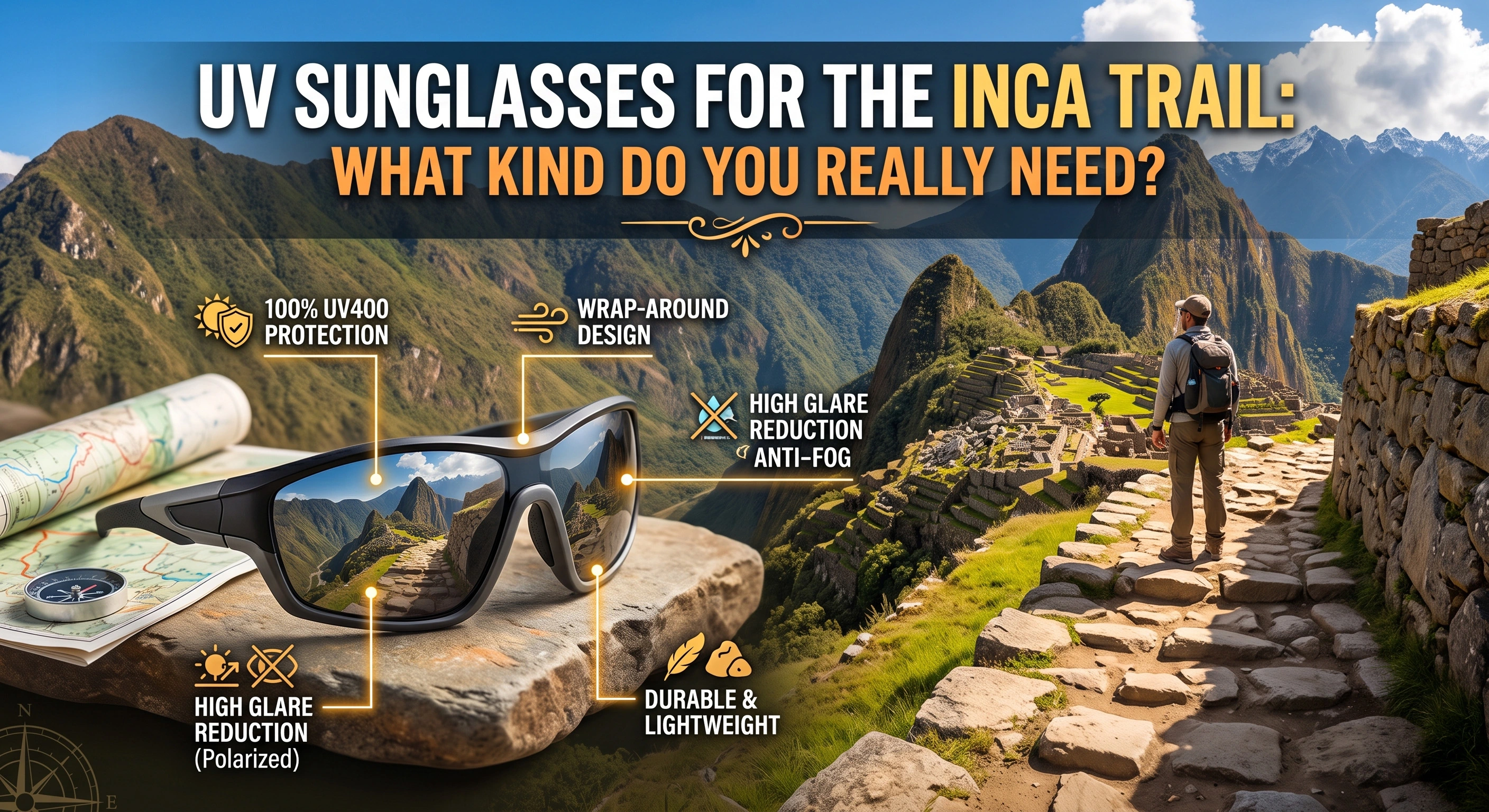
For the Inca Trail, choose sunglasses labeled UV400 or 100% UVA and UVB protection. The ideal pair should have medium-to-large lenses, a close-fitting or wraparound frame, a secure nonslip fit, and durable lenses suitable for hiking. Polarized lenses are helpful for reducing glare, but polarization is not a substitute for UV protection. UV Sunglasses for the Inca Trail.
You do not need expensive designer sunglasses or specialized glacier goggles for a standard Inca Trail trek. What matters most is verified UV protection, sufficient coverage, comfort, and the ability to see uneven stone steps clearly in both bright sun and shaded cloud forest.
The Inca Trail is not an ordinary sightseeing walk. It involves hours of outdoor exposure across changing elevations, open mountain passes, cloud forest, archaeological sites, and ancient stone pathways.
The Classic Inca Trail reaches approximately 4,215 meters, or 13,829 feet, at Dead Woman’s Pass. At that elevation, thinner atmosphere allows more ultraviolet radiation to reach the surface.
The World Health Organization estimates that UV levels increase by approximately 10% for every 1,000 meters of elevation, although actual exposure also depends on latitude, clouds, season, time of day, and reflection.
That makes proper sunglasses an essential safety item, not simply a travel accessory.
Key Takeaways
- Look for UV400 or 99% to 100% UVA and UVB protection.
- Choose a close-fitting or wraparound frame.
- Make sure the sunglasses remain secure while sweating and climbing.
- Medium-dark gray, brown, amber, or green lenses can work well.
- Polarization is useful but optional.
- Dark lenses without verified UV protection should be avoided.
- Large fashion sunglasses can work only if they fit securely and provide complete UV protection.
- Bring a protective case, microfiber cloth, retainer strap, and preferably a backup pair.
- Wear sunglasses even on cool or cloudy days.
- Combine sunglasses with a brimmed hat for better overall protection.
Why Are Sunglasses So Important on the Inca Trail?
Sunglasses are important anywhere you spend extended time outdoors, but several characteristics of the Inca Trail make eye protection particularly necessary.
You will be hiking at high elevation
The Classic Inca Trail reaches its highest point at Dead Woman’s Pass, approximately 4,215 meters above sea level. The route then crosses additional elevated sections before descending toward Machu Picchu, which sits at roughly 2,430 meters.
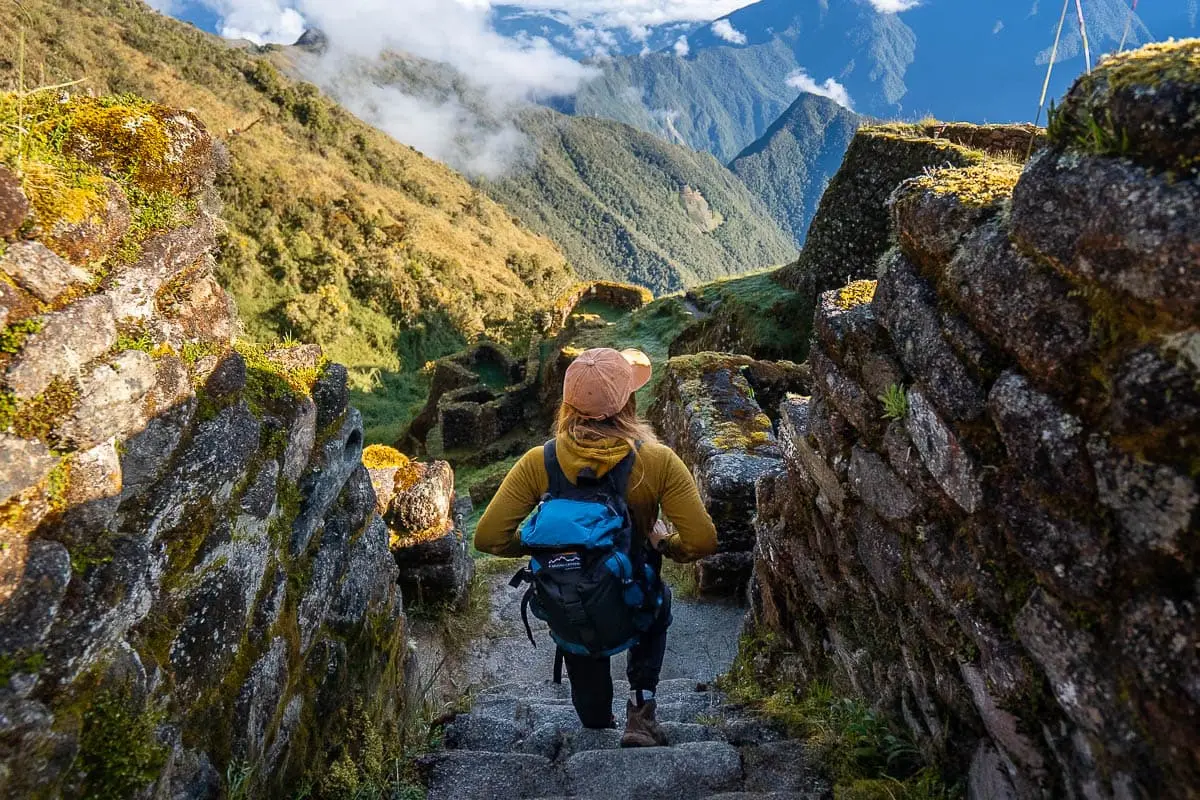
At higher elevations, there is less atmosphere available to absorb ultraviolet radiation. The WHO reports that UV levels increase by approximately 10% with every 1,000-meter increase in altitude. This does not mean UV exposure can be calculated perfectly using elevation alone, but it shows why the sun can be more intense in the Andes than many visitors expect.
For someone arriving from a lower-elevation U.S. city, the difference can be significant.
Peru is closer to the equator than most of the United States
UV radiation is generally stronger closer to the equator because sunlight travels through less atmosphere before reaching the ground. The Inca Trail combines this geographic factor with high elevation and prolonged outdoor activity.
A cool morning in the Andes may therefore expose you to stronger UV radiation than a warm afternoon at home.
Temperature is not a dependable guide to UV intensity. You may feel cold because of wind or altitude while your skin and eyes are still receiving substantial ultraviolet exposure.
You spend several hours outdoors each day
On the Classic Inca Trail, hikers are outside for much of four consecutive days. The route includes long ascents, open passes, exposed ridges, archaeological sites, and sections where shade is limited.
The Short Inca Trail involves less cumulative exposure, but it still includes approximately six hours of hiking during its primary trekking day.
The concern is not only one brief period of intense sunlight. It is the combined effect of multiple hours outdoors.
Clouds do not eliminate UV exposure
The Inca Trail passes through several microclimates, and the weather may shift quickly between sunshine, mist, rain, and cloud cover.
It is tempting to remove your sunglasses when clouds appear. However, ultraviolet radiation can penetrate cloud and haze, and thin cloud may provide less protection than travelers assume. The CDC advises travelers to protect their eyes regardless of atmospheric conditions.
You may occasionally remove sunglasses when visibility becomes too dark, but clouds alone should not be treated as proof that UV exposure has disappeared.
Bright conditions can make technical terrain harder to see
The Inca Trail includes irregular stones, steep stairs, loose surfaces, wet sections, and long descents. Excessive glare can make it harder to recognize differences in depth and texture.
Good sunglasses should reduce uncomfortable brightness without making the trail so dark that you cannot identify changes in footing.
This is why both lens protection and lens usability matter. The darkest possible lens is not automatically the safest hiking lens.
What UV Rating Should Your Sunglasses Have?
The single most important specification is a label stating one of the following:
- UV400
- 100% UV protection
- 99% to 100% UVA and UVB protection
The FDA recommends choosing sunglasses labeled UV400 or 100% UV protection. These lenses block more than 99% of UVA and UVB radiation. The National Eye Institute gives similar guidance and recommends lenses that provide 99% to 100% UVA and UVB protection or carry a UV400 rating.
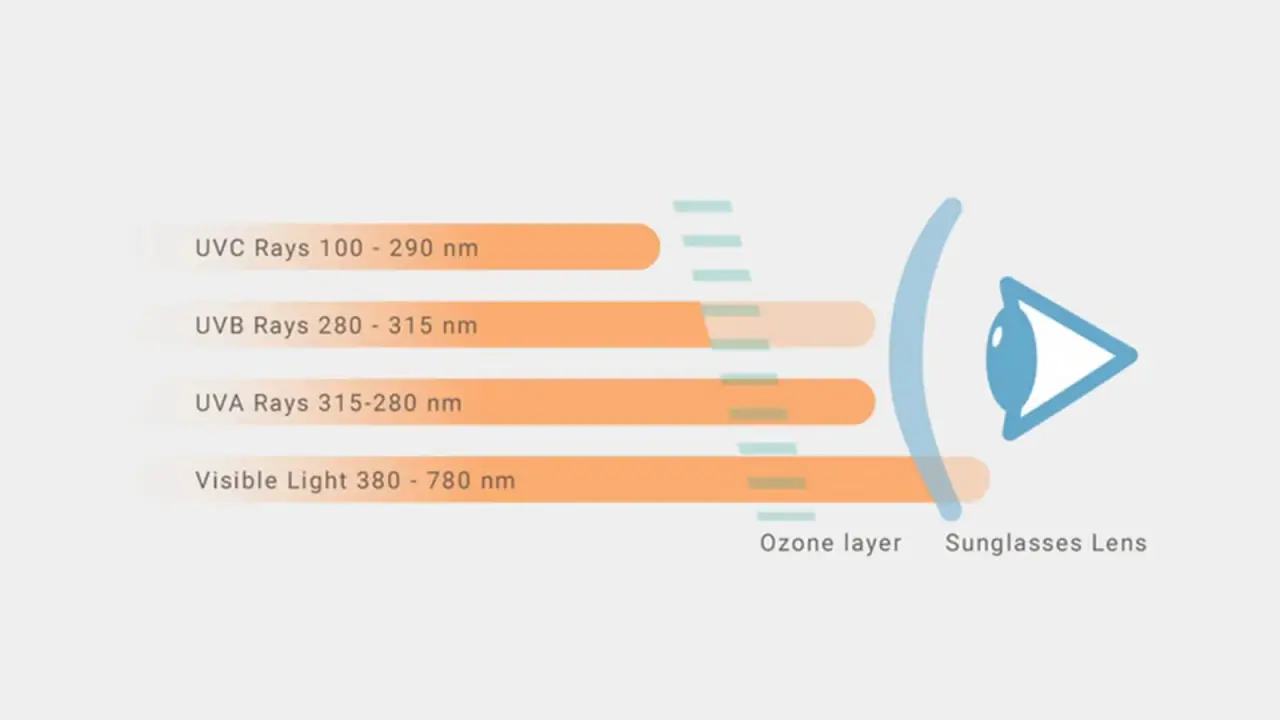
What does UV400 mean?
UV400 means that the lenses are designed to block ultraviolet wavelengths up to 400 nanometers. This covers UVA and UVB radiation reaching the eyes.
For an Inca Trail hiker, UV400 is the simplest and most useful label to look for.
Do not settle for vague phrases such as:
- UV absorbing
- Sun protection
- Blocks harmful rays
- Outdoor lenses
- Dark protection
These descriptions may sound reassuring, but they do not clearly confirm the expected level of protection.
Is 100% UVA and UVB protection the same as UV400?
For practical consumer selection, both labels indicate the level of protection you should seek.
A pair marked “100% UVA and UVB protection” is suitable even if the label does not specifically use the term UV400. Similarly, properly labeled UV400 sunglasses should cover the full UVA and UVB range relevant to outdoor exposure.
Do expensive sunglasses provide better UV protection?
Not necessarily.
The FDA and National Eye Institute both note that price is not a reliable indicator of UV protection. An affordable pair with verified UV400 protection can protect against ultraviolet radiation as effectively as a much more expensive designer pair.
Higher-priced hiking sunglasses may still offer practical advantages such as:
- Better optical clarity
- More comfortable frames
- Lower weight
- Stronger hinges
- Replaceable lenses
- Better ventilation
- Nonslip nose pads
- Improved scratch resistance
- More durable coatings
These features can make a pair more comfortable and reliable during a multi-day trek, but the price itself does not prove that the lenses block UV radiation.
Do You Need Wraparound Sunglasses?
A wraparound or close-fitting design is strongly recommended for the Inca Trail.
Ultraviolet radiation and bright light do not enter only through the front of the lenses. They can reach the eyes from above, below, and around the sides of a small or poorly fitted frame.
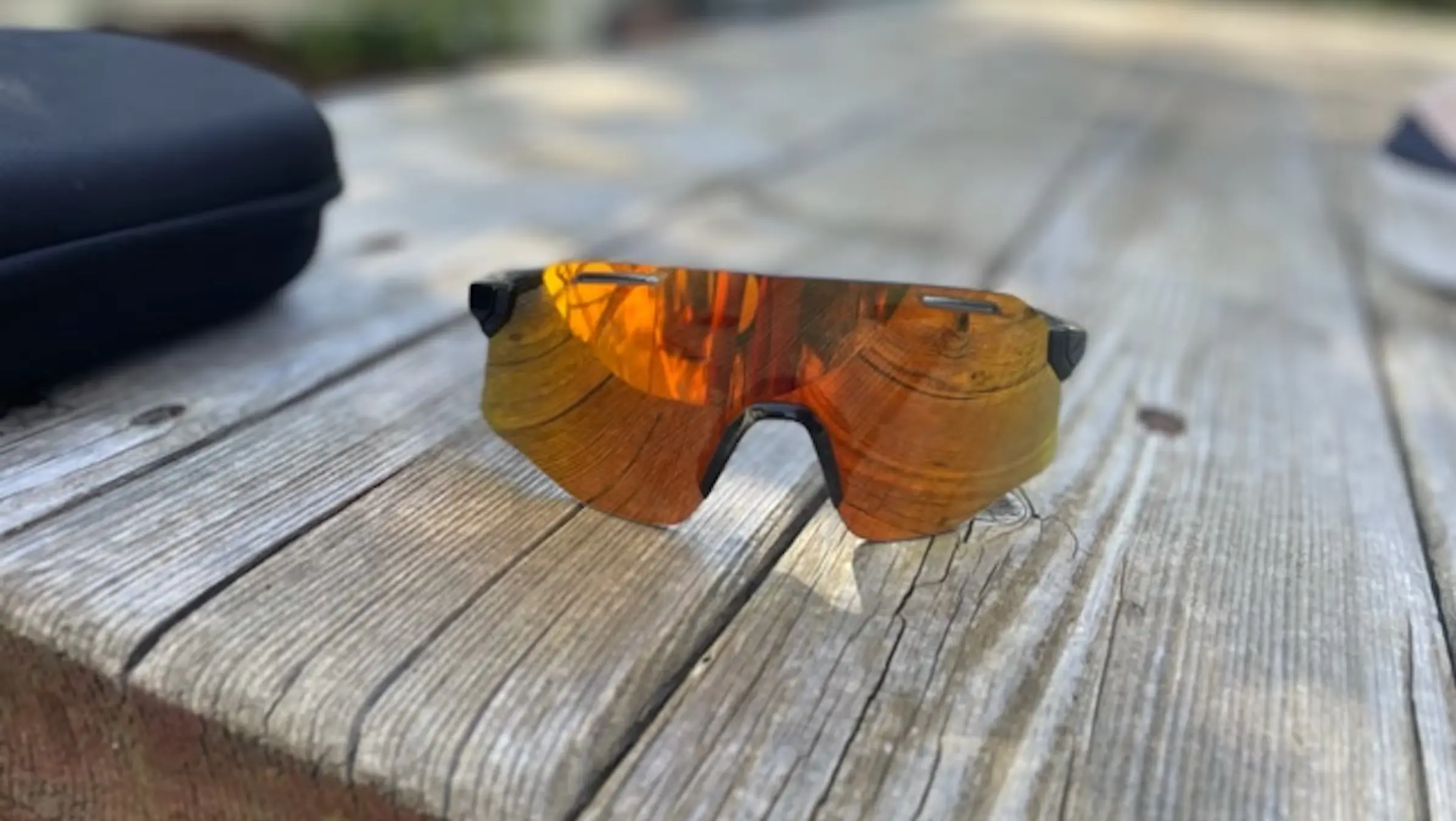
The National Eye Institute recommends choosing sunglasses that stay in place, cover the area around the eyes, and minimize light entering from different directions. The CDC Yellow Book also recommends close-fitting or wraparound frames for improved protection from direct and reflected UV radiation.
Your sunglasses do not need to look like goggles
“Wraparound” does not necessarily mean oversized sports goggles.
A suitable hiking frame may have:
- Moderately curved lenses
- Wider temples
- Medium-to-large lens coverage
- Minimal gaps beside the eyes
- A frame that sits close to the face
- Secure arms that do not slide during movement
The objective is coverage, not a particular style.
Can regular fashion sunglasses work?
They can, provided they meet all the essential requirements.
A fashion-style pair may be suitable when it:
- Has verified UV400 protection
- Covers the eyes adequately
- Does not leave large side gaps
- Stays secure while walking
- Does not become uncomfortable after several hours
- Allows clear vision on uneven ground
Small, narrow lenses and loose frames are less appropriate because they provide limited coverage and may move while you climb.
Should Inca Trail Sunglasses Be Polarized?
Polarized sunglasses are useful for the Inca Trail, but they are not mandatory.
Polarization reduces glare caused by reflected visible light. It can make bright outdoor conditions more comfortable and may reduce squinting and visual fatigue.
The CDC explains that polarized and mirrored lenses are not inherently more effective at blocking ultraviolet radiation. Their main benefit is reducing reflected visible light. The sunglasses must still carry a UV400 or equivalent UV-protection rating.
When might polarization help?
Polarization may be useful when:
- Sunlight reflects from wet stone
- The sky is intensely bright
- You are hiking for several hours in exposed terrain
- Your eyes are sensitive to glare
- You are also traveling by road or train through bright landscapes
- You prefer a sharper-looking view in strong sunlight
What are the disadvantages?
Polarized lenses can make some digital screens appear dark, distorted, or difficult to read at certain angles. Test your phone, camera, smartwatch, and GPS device before your trip.
This is usually a minor inconvenience rather than a reason to avoid polarized sunglasses.
Final verdict on polarization
Choose polarized lenses when they fit your budget and feel comfortable. However, prioritize the following first:
- Verified UV400 protection
- Sufficient coverage
- Secure fit
- Optical clarity
- Hiking comfort
A high-quality nonpolarized UV400 pair is safer than a polarized pair with uncertain UV protection.
What Lens Color Is Best for the Inca Trail?
There is no single lens color that every hiker must use.
The CDC notes that tint color does not determine UV protection. Gray lenses provide particularly accurate color perception, while other colors can still provide excellent UV protection when properly rated.
The Gray lenses
Gray is one of the most versatile choices for the Inca Trail.
Advantages include:
- Natural color perception
- Comfortable brightness reduction
- Good performance in strong sunlight
- Minimal color distortion
- Easy transition between sightseeing and hiking
Gray is a dependable choice for travelers who do not want to overthink lens color.
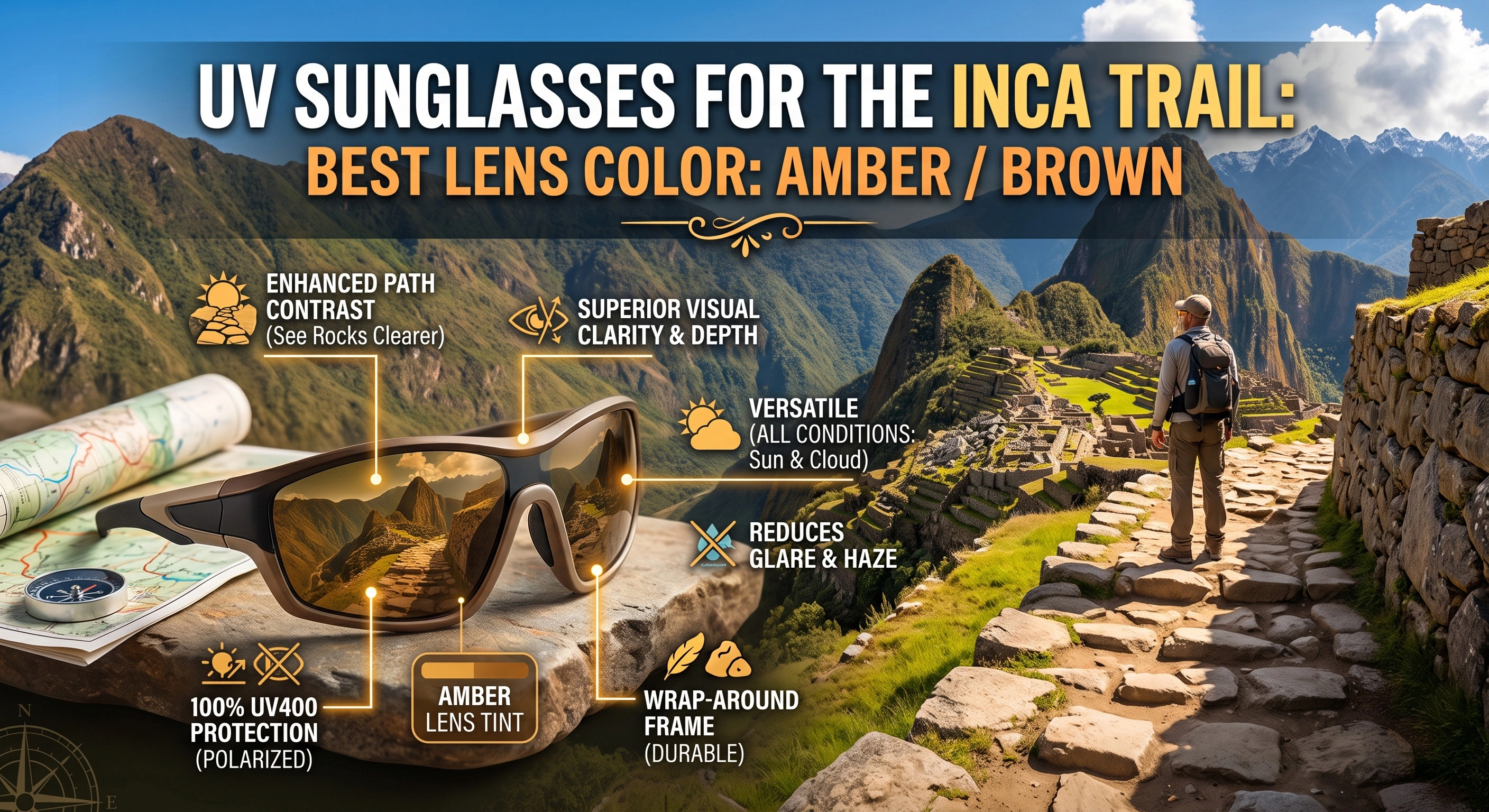
Brown or amber lenses
Brown and amber lenses create warmer color perception. Some hikers prefer them because terrain contours and differences between rock, soil, and vegetation can appear more distinct.
Possible benefits include:
- Comfortable contrast in mixed conditions
- Useful visibility during partly cloudy weather
- A warmer view of the landscape
- Better perceived definition for some wearers
The tradeoff is that colors may not look completely natural.
Green lenses
Green lenses can provide balanced brightness reduction while preserving relatively natural color perception.
They are a reasonable alternative for travelers who find gray lenses too neutral or brown lenses too warm.
Yellow or very light amber lenses
Light yellow lenses are mainly designed for low-light contrast rather than intense midday sun.
They may be useful as a secondary lens during dim, foggy, or early-morning conditions, but they should not be your only pair unless they provide verified UV400 protection and sufficient visible-light reduction for bright conditions.
Very dark lenses
Very dark lenses can be uncomfortable when you enter shaded forest or walk on irregular stone steps. They may require frequent removal as the light changes.
Darkness also does not prove UV protection. The FDA warns that tinted lenses without UV protection can be harmful because the darker environment causes the pupils to dilate while UV radiation may still reach the eyes.
Choose lenses that reduce brightness comfortably without making shaded terrain difficult to see.
How Dark Should the Lenses Be?
For most Inca Trail hikers, a medium-to-dark daytime lens is appropriate.
Your sunglasses should allow you to:
- See steps clearly
- Recognize wet or loose stones
- Read trail signs
- View the landscape without squinting
- Move from open sunlight into partial shade
- Identify facial expressions and guide signals
- Use your phone or camera when necessary
Test the lenses outdoors rather than only inside a store.
Walk in direct sun, tree shade, and changing light. If you repeatedly need to remove the sunglasses to see the ground, the lenses may be too dark for mixed hiking terrain.
What Lens Material Is Best?
Polycarbonate is a practical choice for trekking because it is lightweight and resistant to impact. Other quality plastic lens materials can also work well.
The National Eye Institute notes that sunglasses may use plastic, polycarbonate, or other lens materials and emphasizes verified UV protection, lens quality, fit, and suitability for the intended activity.
For the Inca Trail, look for lenses described as:
- Impact resistant
- Shatter resistant
- Scratch resistant
- Lightweight
- Suitable for sports or outdoor activity
No consumer lens is completely unbreakable or scratch-proof. A hard case remains important.
Are glass lenses a good choice?
Glass lenses can provide excellent optical clarity and scratch resistance, but they are often heavier than plastic sports lenses.
They may be suitable for casual Machu Picchu sightseeing, but many hikers prefer a lighter lens that remains comfortable during several hours of climbing.
Are mirrored lenses better?
Mirrored coatings reduce the amount of visible light reaching the eyes and can be comfortable in very bright conditions.
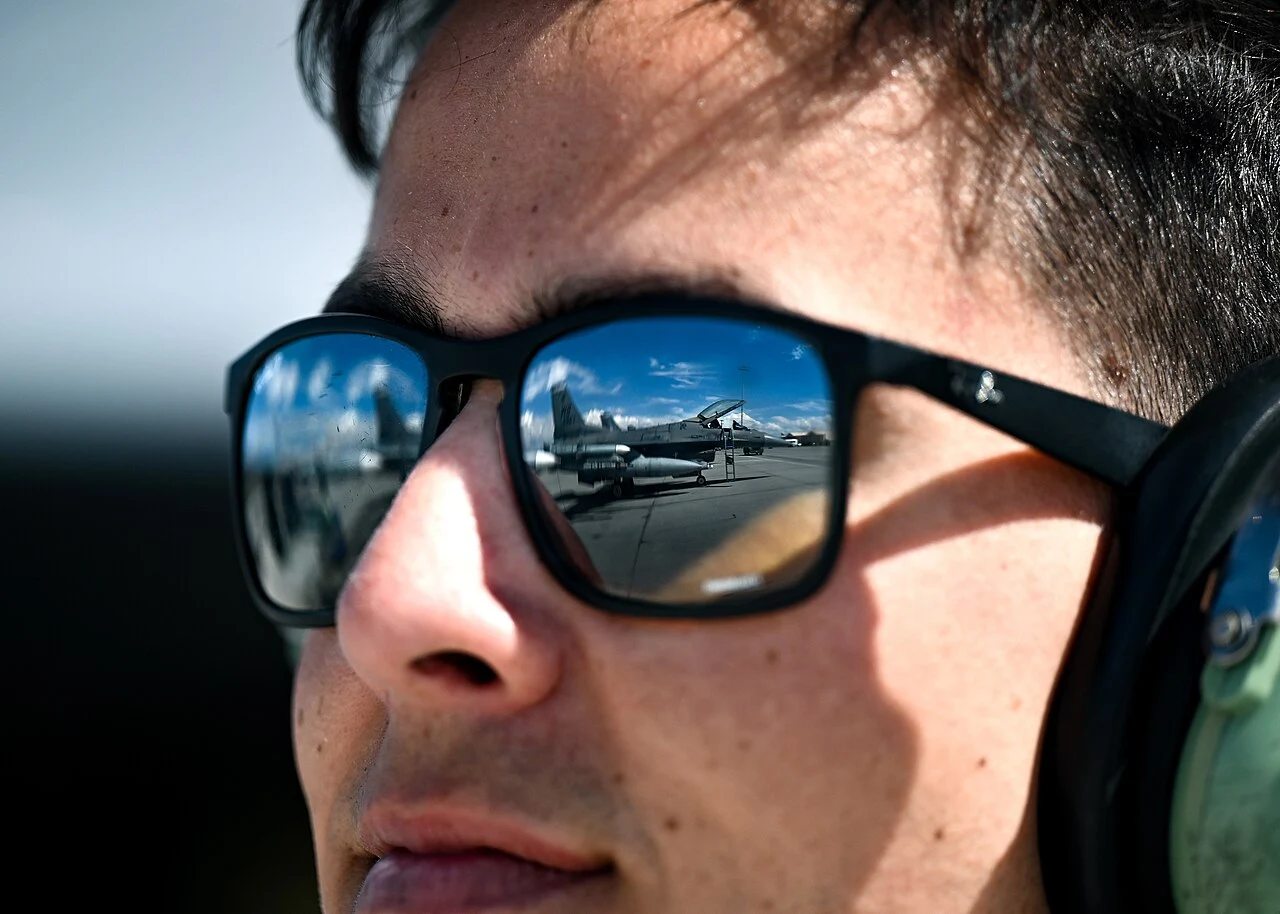
However, a mirrored appearance does not guarantee UV protection. Confirm that the underlying lens is also rated UV400 or provides 100% UVA and UVB protection.
Comparison of Sunglass Features for the Inca Trail
| Sunglass feature | Is it necessary? | Primary benefit | Important limitation |
| UV400 protection | Yes | Blocks more than 99% of UVA and UVB radiation | Must be verified on the label |
| Wraparound coverage | Strongly recommended | Reduces light entering from the sides | Must still fit comfortably |
| Polarized lenses | Optional but useful | Reduces reflected glare | Does not automatically provide UV protection |
| Gray tint | Recommended | Preserves natural colors | May offer less perceived contrast than brown |
| Brown or amber tint | Recommended option | Can make terrain appear more defined | Alters color perception |
| Mirrored coating | Optional | Reduces visible brightness | Does not prove UV protection |
| Photochromic lenses | Optional | Adapt to changing light | May not become dark enough for every wearer |
| Gradient lenses | Usually unnecessary | Useful for driving or casual use | Lower section may be too bright for exposed trails |
| Impact-resistant lenses | Strongly recommended | Better durability during hiking | Still require careful storage |
| Glacier glasses | Usually unnecessary | Maximum coverage in snow and extreme glare | Often too dark or restrictive for standard Inca Trail conditions |
Do You Need Glacier Glasses?
Most travelers do not need full glacier glasses for the standard Inca Trail.
Glacier glasses are designed for environments with intense reflected light from extensive snow and ice. They commonly have very dark lenses and protective side shields.
Although the Classic Inca Trail rises above 4,000 meters, it does not normally involve continuous travel across glaciers or snowfields. Alpaca Expeditions’ packing guidance emphasizes UV-protective sunglasses while noting that specialized snow-condition protection is generally more than is required for Machu Picchu trekking.
A quality wraparound pair of UV400 hiking sunglasses is normally sufficient.
Glacier-style eyewear may be considered when:
- Your itinerary includes a separate snow-covered mountaineering route
- An eye-care professional has advised stronger protection
- Unusual seasonal conditions are expected
- You have significant light sensitivity
- You are combining the Inca Trail with a higher alpine expedition
Ask your trekking team about expected conditions when your itinerary includes routes beyond the standard Inca Trail.
Are Photochromic Sunglasses Suitable?
Photochromic lenses darken in response to ultraviolet exposure and become lighter when UV levels decrease.
They can be convenient on the Inca Trail because hikers frequently move between:
- Bright mountain passes
- Cloud forest
- Mist
- Early-morning light
- Archaeological structures
- Open viewpoints
- Shaded campsites
However, photochromic performance differs between products. Some lenses may not become dark enough for people who are highly sensitive to intense sunlight.
Before relying on them:
- Confirm that they provide UV400 protection.
- Test them in strong outdoor sunlight.
- Check how quickly they lighten in shade.
- Make sure you can see uneven steps during the transition.
- Consider carrying a darker backup pair.
Prescription photochromic lenses may be especially convenient for travelers who do not want to switch constantly between regular glasses and sunglasses.
What About Prescription Sunglasses?
Prescription sunglasses are an excellent option when you need vision correction throughout the trek.
Choose prescription lenses that provide:
- UV400 or 100% UVA and UVB protection
- A secure frame
- Adequate side coverage
- Durable lens material
- A current prescription
- Comfortable all-day vision
Bring your regular prescription glasses as a backup. Keep them in a hard case inside your daypack rather than in the porter-carried duffel bag, because you may need immediate access to them.
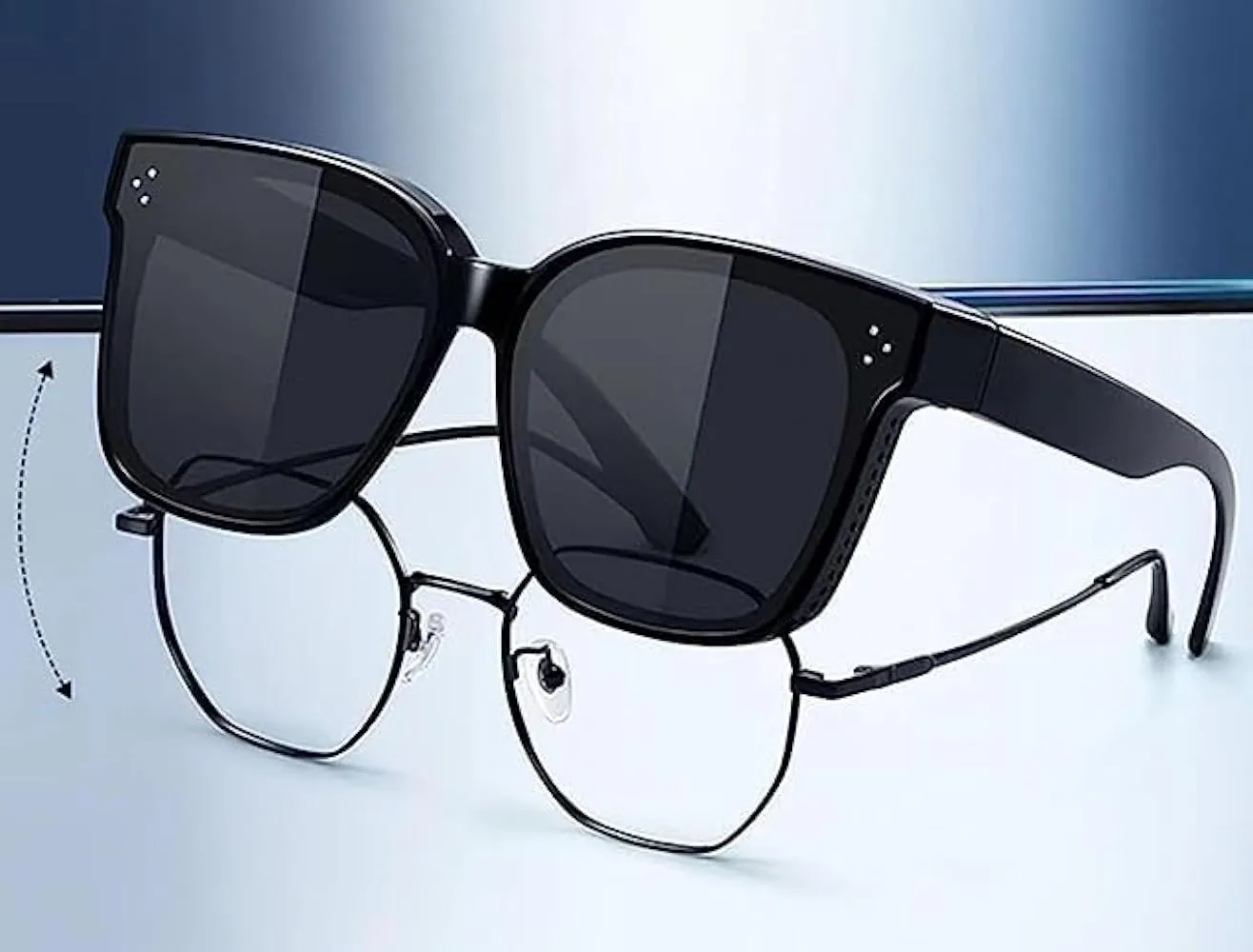
Can you wear sunglasses over regular glasses?
Fit-over sunglasses can work well when they:
- Completely cover your prescription frames
- Do not press uncomfortably on your face
- Stay secure during climbing
- Do not create excessive fogging
- Provide verified UV400 protection
Test the full combination during training hikes.
Can Contact Lens Wearers Rely on UV-Blocking Contacts?
No. UV-blocking contact lenses should not replace sunglasses.
Contacts cover only part of the eye and do not protect the eyelids or skin surrounding the eyes. The FDA and National Eye Institute recommend wearing UV-protective sunglasses even when using UV-absorbing contact lenses.
Contact lens users should also consider the practical challenges of a multi-day trek:
- Dust
- Wind
- Dry air
- Limited hand-washing facilities
- Early mornings
- Rain
- Tiredness
- Difficulty cleaning or replacing lenses outdoors
Bring backup prescription glasses, lens supplies, clean hands-free storage, and any eye-care products recommended by your optometrist.
Which Sunglasses Are Best for the Classic and Short Inca Trails?
The same UV standard applies to both routes, but the preferred design may differ slightly.
Classic Inca Trail
For the four-day Classic Inca Trail, prioritize:
- UV400 protection
- Wraparound or close-fitting coverage
- Lightweight construction
- Secure nose and temple grips
- Durable hinges
- Impact-resistant lenses
- Comfortable all-day fit
- Scratch-resistant coating
- A retainer strap
- A backup pair
The Classic route has more cumulative sun exposure and reaches Dead Woman’s Pass at approximately 4,215 meters.
Durability and long-term comfort therefore matter more than fashionable appearance.
Short Inca Trail
The Short Inca Trail usually involves one substantial hiking day of approximately six hours, followed by Machu Picchu sightseeing.
You still need full UV400 protection, but a lightweight travel-sport frame may be sufficient. Ensure the glasses remain secure during steep steps and do not become uncomfortable after several hours.
Machu Picchu without a multi-day trek
Travelers arriving by train still need UV-protective sunglasses.
Machu Picchu is lower than Cusco and Dead Woman’s Pass, but it remains at approximately 2,430 meters and involves outdoor walking on exposed terraces and pathways.
A comfortable UV400 pair with good coverage is appropriate.
How Should Sunglasses Fit for Hiking?
Fit can make the difference between sunglasses you wear all day and sunglasses that remain inside your backpack.
Your pair should:
- Stay in place when you look downward
- Remain stable while climbing stairs
- Avoid pressing behind your ears
- Sit comfortably under a hat
- Leave enough ventilation to limit fogging
- Avoid touching your eyelashes
- Provide coverage without obstructing peripheral vision
- Feel secure when your face becomes sweaty
- Remain comfortable for several consecutive hours
Perform a pre-trip movement test
Wear the sunglasses and complete the following:
- Look sharply up and down.
- Shake your head gently from side to side.
- Walk quickly up and down stairs.
- Bend forward as if tightening a boot.
- Wear your intended hiking hat.
- Put on your daypack.
- Walk outside for at least 30 minutes.
- Test them while sweating.
- Check visibility in shade and sunlight.
- View your phone and camera screens.
Do not wait until Peru to discover that the frame slides down your nose or causes pressure headaches.
Should You Wear Sunglasses on Cloudy Days?
Yes, whenever the conditions remain bright enough to see safely through the lenses.
UV radiation can pass through clouds and haze. Cloud cover may reduce some exposure, but it does not reliably remove the need for eye protection.
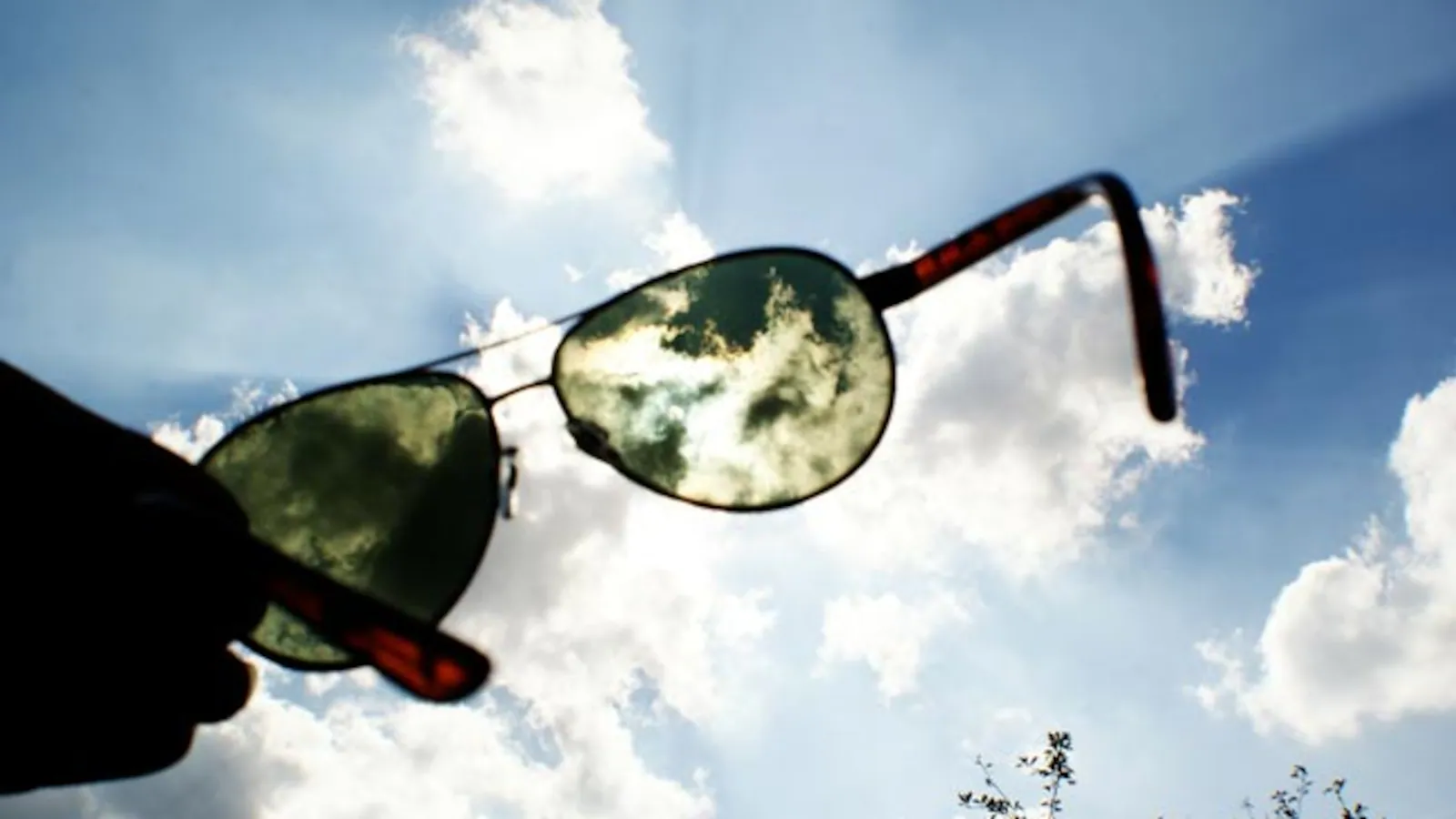
Keep the sunglasses accessible during:
- Overcast weather
- Light rain
- High-elevation mist
- Intervals between clouds
- Cool mornings
- Windy mountain conditions
When the trail becomes genuinely dark, remove the sunglasses temporarily so you can see your footing. Store them securely rather than balancing them on your head.
Common Sunglass Mistakes Inca Trail Hikers Make
Mistake 1: Choosing lenses based only on darkness
A dark tint does not confirm UV protection. Always check for UV400 or 99% to 100% UVA and UVB protection.
Mistake 2: Assuming polarized means UV-protective
Polarization controls glare. UV protection controls ultraviolet exposure. A pair can have one feature without the other.
Confirm both when buying polarized sunglasses.
Mistake 3: Wearing tiny fashion frames
Small lenses may leave large gaps around the eyes. Choose enough coverage to limit light entering from above and the sides.
Mistake 4: Buying sunglasses immediately before departure
New frames may cause ear pressure, slide during sweating, fog excessively, or distort your vision.
Wear them on several practice hikes first.
Mistake 5: Carrying sunglasses without a case
Loose sunglasses can be scratched by keys, trekking equipment, sand, snack wrappers, or other objects inside your daypack.
A lightweight hard case is worth the small amount of space it requires.
Mistake 6: Keeping sunglasses in the duffel bag
You will need sunglasses during the hiking day. Keep them in your daypack or wear them from the beginning.
Mistake 7: Depending on one fragile pair
Accidents happen. Frames may be dropped, stepped on, scratched, or misplaced.
A lightweight backup pair with verified UV protection is a sensible addition, especially for prescription wearers.
Mistake 8: Forgetting a retainer strap
A simple sports strap helps prevent sunglasses from falling during steep climbs, photographs, rain, or frequent transitions between bright and shaded areas.
Mistake 9: Cleaning lenses with dirty clothing
Dust and fine trail debris can scratch lenses when rubbed with a shirt.
Carry a clean microfiber cloth in a small resealable bag.
Mistake 10: Treating sunglasses as the only sun protection
Sunglasses work best with a wide-brimmed or suitably protective hat. The FDA recommends combining UV-protective sunglasses with a hat and other sun-safety measures.
What Should You Pack With Your Sunglasses?
Include the following in your daypack:
- Primary UV400 sunglasses
- Lightweight backup sunglasses
- Hard protective case
- Microfiber cleaning cloth
- Sports retainer strap
- Small lens-cleaning solution approved for your lenses
- Regular prescription glasses, when needed
- Contact lens supplies, when applicable
- Brimmed sun hat
- Broad-spectrum sunscreen
- SPF lip balm
Alpaca Expeditions includes sunglasses, a sun hat, and sunscreen among recommended trekking sun-protection items.
Where should you store them?
Use an easily accessible daypack pocket that will not be compressed by a water bottle or camera.
At camp, return the glasses to their case. Avoid leaving them:
- On the ground
- Inside a tent entrance
- On top of a sleeping bag
- Hanging from a loose shirt collar
- Exposed to heavy rain
- Lens-down on a table or rock
How Can You Prevent Fogging?
Fogging can occur when warm breath, sweat, humidity, or rapid temperature changes cause condensation on cooler lenses.
Reduce fogging by choosing:
- A frame with adequate ventilation
- Lenses with an anti-fog coating
- Adjustable nose pads
- A fit that does not press completely against the face
- A hat that does not force the frame downward
During uphill hiking, avoid wiping fogged lenses repeatedly with dirty fabric. Pause safely, remove the glasses, and use a clean microfiber cloth.
Test anti-fog products before the trip because some solutions may not be suitable for every coating.
What Eye Symptoms Require Attention?
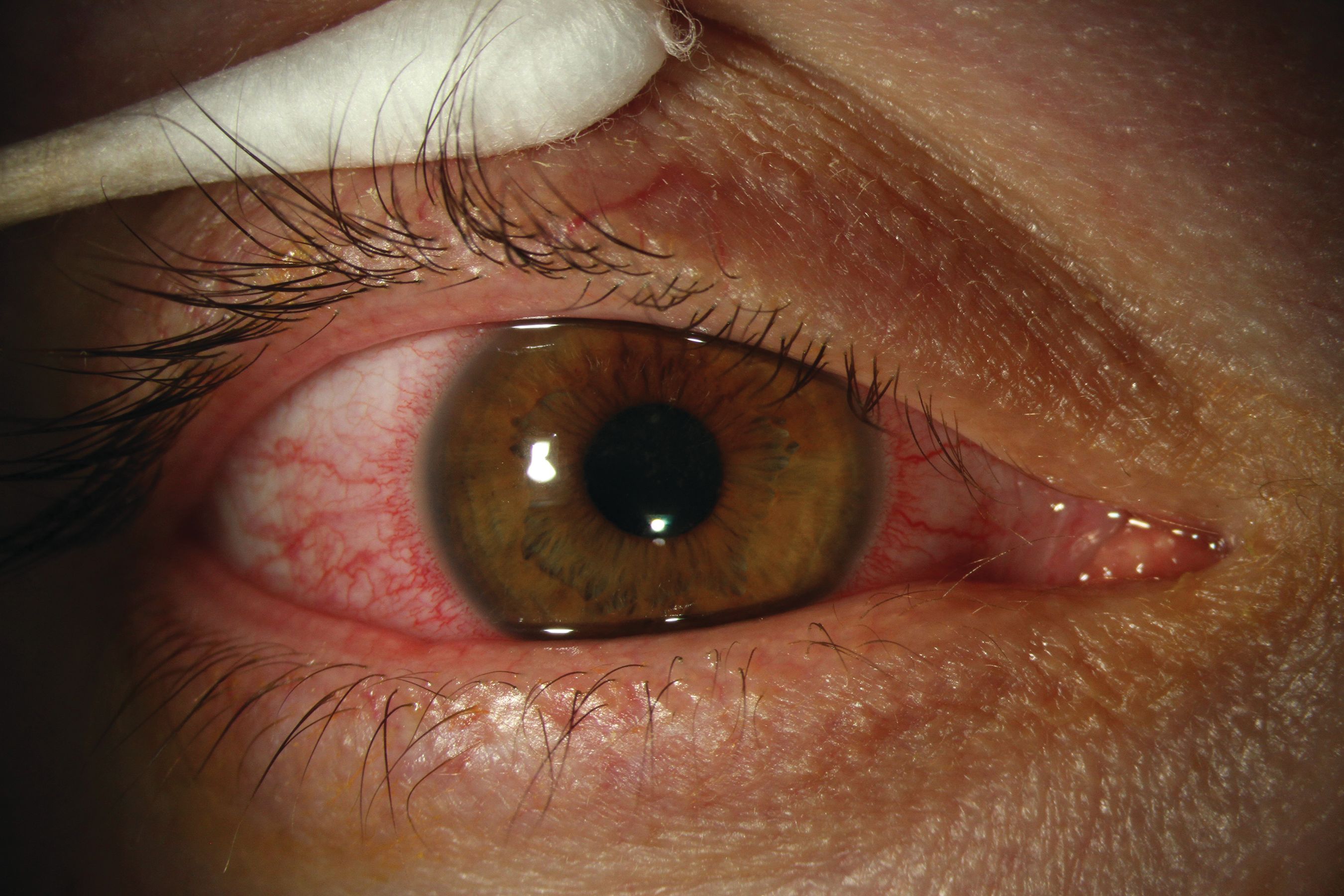
Most hikers will not experience a serious eye problem. However, intense ultraviolet exposure can cause photokeratitis, sometimes called corneal sunburn or snow blindness.
Possible symptoms include:
- Significant eye pain
- Strong sensitivity to light
- Excessive tearing
- Red eyes
- A gritty or foreign-body sensation
- Blurred vision
- Difficulty keeping the eyes open
Symptoms can appear after the exposure rather than immediately. The CDC describes photokeratitis as extremely painful and potentially disabling during the period when symptoms are present.
Tell your guide promptly if you develop eye pain, unusual light sensitivity, vision changes, or persistent redness. Seek evaluation from a qualified medical or eye-care professional rather than assuming the condition is simple tiredness or dust irritation.
Do not continue hiking over technical terrain when your vision is impaired.
Is Dry Eye Common During High-Altitude Travel?
Wind, low humidity, dust, sun exposure, long flights, contact lens use, and fatigue can all make the eyes feel dry or irritated.
Wraparound sunglasses can help reduce direct wind exposure. The National Eye Institute also recommends wraparound sunglasses as one measure for people dealing with dry-eye symptoms outdoors.
Travelers with an existing eye condition should discuss the trip with their eye-care professional. Bring the products specifically recommended for your eyes rather than experimenting with unfamiliar drops during the trek.
Should You Buy Sunglasses Before Arriving in Peru?
Buying them before departure is usually the better option.
It gives you time to:
- Verify the UV rating
- Compare frame sizes
- Test comfort
- Check prescription accuracy
- Confirm phone-screen visibility
- Try them with your hiking hat
- Use them during training hikes
- Return or exchange an unsuitable pair
If you already own sunglasses but cannot confirm their UV protection, an optical shop may be able to test them using a photometer. The National Eye Institute specifically notes that many optical shops have equipment for checking UV-blocking performance.
You can purchase sunglasses in Cusco, but relying on a last-minute purchase reduces your opportunity to test comfort and authenticity.
How Much Should You Spend?
You do not need a luxury budget.
A practical Inca Trail pair should offer:
- Verified UV400 protection
- Clear, distortion-free lenses
- Secure fit
- Sufficient coverage
- Reasonable durability
- Comfortable weight
Spending more may provide better coatings, frame construction, warranty coverage, or optical quality. However, an expensive logo does not replace the need to check the UV label.
Budget separately for a backup pair, especially when your sunglasses contain prescription lenses.
How Alpaca Expeditions Helps Travelers Prepare
Good preparation extends beyond selecting one item of equipment.
Alpaca Expeditions provides trekking information and packing guidance that includes sunglasses, sunscreen, hats, layered clothing, rain protection, water, and other essential daypack items. Its Classic Inca Trail itinerary also clearly identifies Dead Woman’s Pass as the highest point of the trek at approximately 4,215 meters.
Review the packing information before your pre-trek briefing. Bring your sunglasses to the briefing when you are uncertain about their design or suitability, and ask about the expected weather and trail conditions for your departure.
The final choice remains personal, but local itinerary knowledge can help you avoid packing eyewear that is too fragile, too dark, or poorly suited to changing Andean conditions.
Inca Trail Sunglasses Buying Checklist
Before purchasing or packing your sunglasses, confirm each item below.
Essential requirements
- The label says UV400 or 100% UVA and UVB protection.
- The lenses are free of obvious distortion.
- The frame covers the eyes from the front and sides.
- The sunglasses remain secure when looking downward.
- The lens is dark enough for bright daylight.
- The lens is not too dark for mixed hiking conditions.
- The frame is comfortable under your hiking hat.
- You have tested the glasses outdoors.
- You have a protective case.
- You have a microfiber cloth.
Strongly recommended
- Impact-resistant lens material
- Scratch-resistant coating
- Nonslip nose pads or temples
- Retainer strap
- Lightweight backup pair
- Polarization for glare reduction
- Anti-fog design or coating
For prescription or contact lens users
- Current prescription
- Backup regular glasses
- UV-protective sunglasses over contact lenses
- Contact lens supplies stored hygienically
- Eye-care products recommended by your provider
Final Recommendation: What Kind Do You Really Need?
For most Inca Trail travelers, the best choice is a lightweight, close-fitting pair of UV400 hiking sunglasses with medium-to-large lenses, a secure frame, and impact-resistant construction.
Gray lenses are the safest all-purpose choice for natural color perception. Brown or amber lenses are also suitable when you prefer greater perceived terrain contrast. Polarization is helpful for glare but not essential.
You generally do not need glacier goggles, extremely dark mountaineering lenses, or an expensive designer pair. You do need clear evidence of UV protection, comfortable coverage, and a frame that stays in place during long climbs.
Test your sunglasses before leaving the United States, pack a backup pair, and keep them accessible throughout the trek. Combined with a brimmed hat and sensible sun protection, the right sunglasses will help you enjoy the Inca Trail’s mountain passes, cloud forest, archaeological sites, and unforgettable approach to Machu Picchu more comfortably and safely.
Frequently Asked Questions
1. What are the best sunglasses for the Inca Trail?
The best sunglasses for the Inca Trail provide UV400 or 100% UVA and UVB protection, good side coverage, a secure nonslip fit, and durable lenses. A lightweight wraparound hiking frame with gray or brown lenses is suitable for most travelers. Polarization is helpful but optional.
2. Do I need polarized sunglasses for the Inca Trail?
No, polarized sunglasses are not mandatory. They can reduce glare and make bright conditions more comfortable, but polarization does not automatically block UV radiation. Always confirm that polarized sunglasses are also labeled UV400 or 100% UVA and UVB protection.
3. Is UV400 enough for high-altitude hiking?
UV400 is the appropriate protection rating to seek for the Inca Trail. It indicates protection across the UVA and UVB wavelengths relevant to outdoor exposure. Coverage and fit also matter, so pair UV400 lenses with a close-fitting or wraparound frame.
4. Are darker sunglasses better for the Inca Trail?
Not automatically. Lens darkness affects visible brightness, while the UV400 rating determines ultraviolet protection. Extremely dark lenses may make shaded stone steps difficult to see. Choose a medium-to-dark lens that remains usable in changing light.
5. What lens color is best for hiking to Machu Picchu?
Gray is a versatile choice because it reduces brightness while preserving natural colors. Brown or amber lenses may make terrain contrast feel more noticeable, although they create a warmer color view. Both are suitable when they provide verified UV400 protection.
6. Do I need glacier glasses at Dead Woman’s Pass?
Most hikers do not need glacier glasses for the standard Classic Inca Trail. Dead Woman’s Pass is high, but the regular route does not normally involve continuous snowfield or glacier travel. UV400 wraparound hiking sunglasses are usually sufficient.
7. Can I use ordinary fashion sunglasses?
Yes, but only when they provide UV400 protection, cover the eyes adequately, remain secure during movement, and allow you to see uneven ground clearly. Small or loose fashion frames are less suitable for long trekking days.
8. Should I wear sunglasses when it is cloudy?
Yes, when there is enough visible light to wear them safely. UV radiation can penetrate cloud and haze. Remove sunglasses temporarily only when conditions become too dark to see the trail clearly.
9. Can I wear contact lenses on the Inca Trail?
Many travelers hike with contact lenses, but UV-blocking contacts do not replace sunglasses. Contacts do not protect the entire eye or surrounding skin. Bring UV400 sunglasses, backup prescription glasses, and appropriate lens-care supplies.
10. Should I bring a spare pair of sunglasses?
A backup pair is strongly recommended. Sunglasses can be dropped, scratched, misplaced, or damaged during a multi-day trek. The backup does not need to be expensive, but it should provide verified UV400 protection.
11. Are cheap UV400 sunglasses safe?
Affordable sunglasses can provide excellent UV protection when they are accurately labeled and free of optical distortion. Price alone does not determine protection. Buy from a reputable seller and have uncertain lenses tested by an optical professional.
12. Are mirrored sunglasses good for the Inca Trail?
Mirrored lenses can reduce visible brightness and may feel comfortable in strong sunlight. The mirror coating does not guarantee UV protection, so check that the lenses are also labeled UV400 or 100% UVA and UVB protection.
13. Are photochromic lenses good for the Inca Trail?
Photochromic lenses can work well because the route moves between open passes, cloud forest, mist, and shade. Test them before departure to ensure they become dark enough in strong sun and lighten quickly enough for shaded terrain.
14. What should I do if my eyes hurt after hiking?
Tell your guide and seek medical evaluation if you develop significant eye pain, unusual light sensitivity, blurred vision, excessive tearing, or difficulty keeping your eyes open. These symptoms can have several causes and should not be self-diagnosed on the trail.
15. Can children use regular sunglasses on the Short Inca Trail?
Children should wear properly fitted sunglasses labeled UV400 or 100% UVA and UVB protection. Avoid toy sunglasses without a verified protection rating. A secure strap and brimmed hat can help keep the sunglasses in place.