


Rainbow Mountain Uncovered: Essential Tips for an Unforgettable Trek
A Rainbow in the Sky Meets the Mountain
Imagine climbing through a landscape of ochre hills and tufted golden grass, your breath becoming shallower as the air thins, when suddenly a sweep of painted rock unfurls before you like a giant ribbon. The slope rises in a series of candy stripes-crimson, turquoise, saffron, lavender and emerald-stacked one on top of another as if a master painter had brushed swathes of colour across the Andes. Rainbow Mountain Uncovered.
This is Rainbow Mountain, or Vinicunca, a geological wonder in Peru’s Cusco region that only came to global attention in the last decade. For centuries it slept beneath glaciers; as climate change melted the ice, the multicoloured bands were revealed, captivating the imagination of travellers around the world.
Rainbow Mountain Uncovered:
If Machu Picchu represents the ingenuity of human civilisation in the Andes, Rainbow Mountain represents nature’s own artistry. Hiking to 5,200 m above sea level is not for the faint‑hearted, but those who make the trek are rewarded with panoramic vistas of the snow‑capped Ausangate massif and the shimmering Red Valley, along with an intimate connection to the living culture of the Quechua people.
This guide is designed for adventurers from the United States and United Kingdom who want not only to visit Rainbow Mountain but to do so safely, responsibly and knowledgeably. Along the way we will explore the mountain’s geology, weather, hiking routes, health considerations, cultural rituals and the ethical dimensions of trekking in high‑altitude Peru.
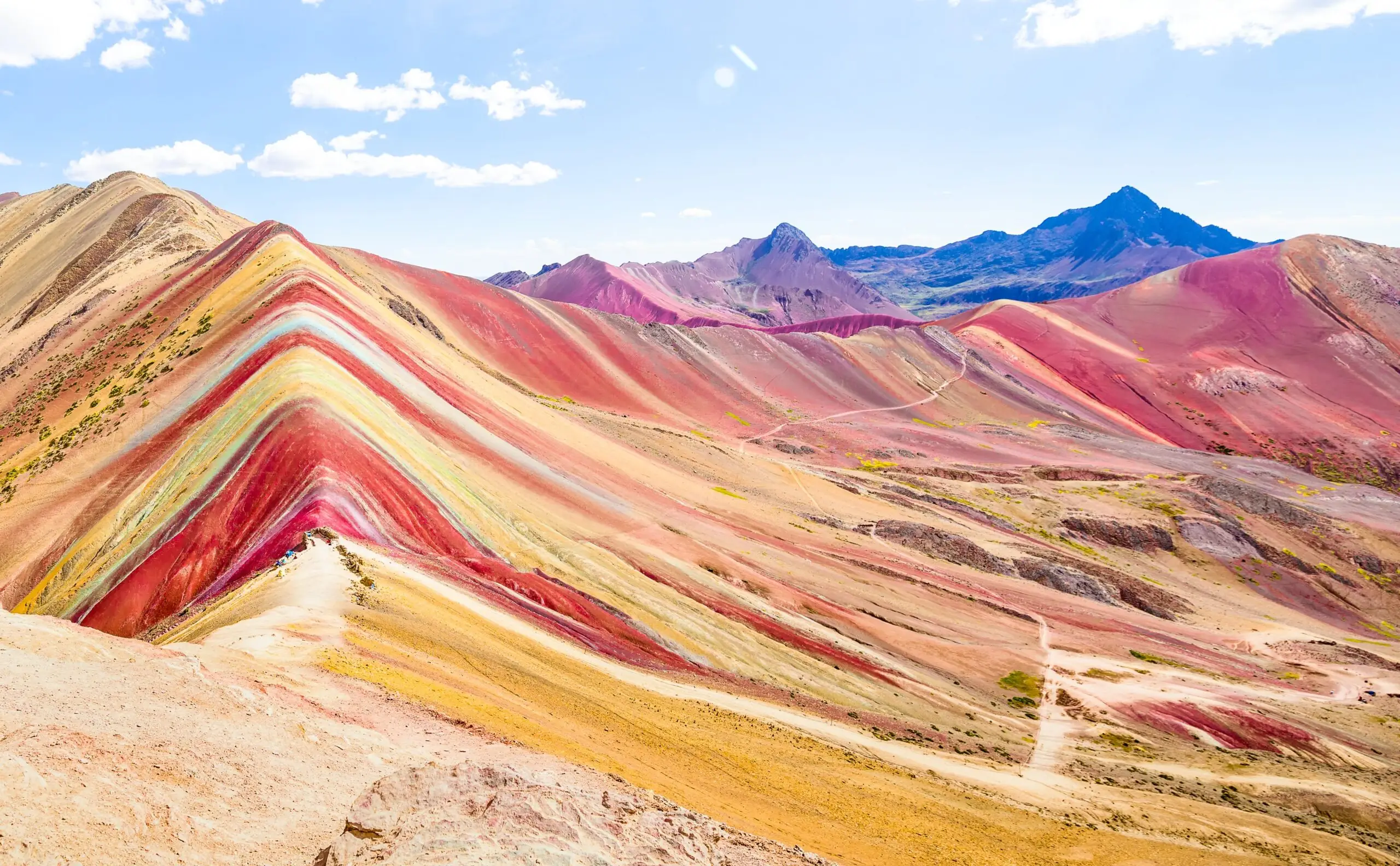
Rainbow Mountain Uncovered
Rainbow Mountain and Its Place in Peru
Rainbow Mountain is part of the Vilcanota range in the southern Andes. It sits roughly 100 km south‑east of Cusco, between the districts of Pitumarca and Cusipata. This remote area, once known mainly to local herders of llamas and alpacas, has become a symbol of Peru’s natural diversity and a must‑see attraction for hikers and photographers.
Yet the colours are not painted; they are the result of complex geological processes that we will delve into shortly. The mountain is also deeply significant to Quechua communities, who view high peaks as Apus or protective spirits and perform rituals to Pachamama (Mother Earth) to show gratitude for her bounty.
Who Should Use This Guide
This article speaks to a broad audience:
- Adventure travellers seeking an awe‑inspiring day hike or multi‑day trek in Peru’s high Andes.
- First‑timers to high altitude who need clear advice on acclimatisation, health and safety.
- USA/UK visitors looking for flight information, visa requirements and cultural insights tailored to their perspective.
- Ethical tourists who want to ensure their visit benefits local communities, protects the environment and respects porter rights.
- Curious readers who simply want to understand how a mountain can display so many colours.
Expect practical details, vivid storytelling and deep respect for the people and landscapes that make Rainbow Mountain so special.
Geology and the Colours of Rainbow Mountain
How the Andes Painted a Rainbow
The Andes are the result of the ongoing collision between the Nazca and South American tectonic plates. Over millions of years, layers of marine and terrestrial sediments accumulated in shallow seas and riverbeds.
These layers-composed of red clays, mudstones, sandstones rich in calcium carbonate, phyllites containing magnesium and iron, and ferromagnesian compounds-were then folded, faulted and thrust upward by tectonic forces. Glacial erosion planed away softer layers, exposing the coloured bands. Only recently, as climate change accelerated glacial retreat, did the full spectrum of colours become visible.
Vinicunca’s colours are not uniform; they vary in width and intensity depending on the thickness of each sedimentary layer and the degree of weathering. Iron oxides create red and pink hues; copper compounds impart green tones; calcium carbonate yields whites and creams; limonite and sulfurous minerals produce yellows; and claystones and phyllites contribute purples and blues.
When light strikes the mountain at different angles-particularly during sunrise and sunset-the colours seem to glow. Rainfall and snow can temporarily dull or saturate the hues, making each visit unique.
Colour Band Table
| Colour | Main Minerals & Deposits | Appearance | Significance |
| Pink / Pale Red | Red clay, mudstone, sand | Delicate rosy bands; best seen when dry | Indicative of iron oxide and the oxidation of iron‑rich sediments |
| White | Sandstone and quartzite rich in calcium carbonate | Thin white or cream lines | Reflects high carbonate content and marine origins |
| Red | Clays and shale with iron oxide | Intense crimson stripes | Produced by oxidation of ferrous minerals and ancient fluvial deposits |
| Green / Turquoise | Phyllite and clay rich in ferromagnesian compounds | Bands of greenish or turquoise tones | Signals the presence of magnesium and copper; similar minerals colour the Red River during rains |
| Brown | Rocks and magnesium, possibly sandstone | Earthy hues between brighter colours | Formed from magnesium‑bearing rocks, connecting the layers |
| Yellow | Limonite and calcareous sandstone | Bright yellow stripes | Indicates sulfurous minerals and oxidised limonite |
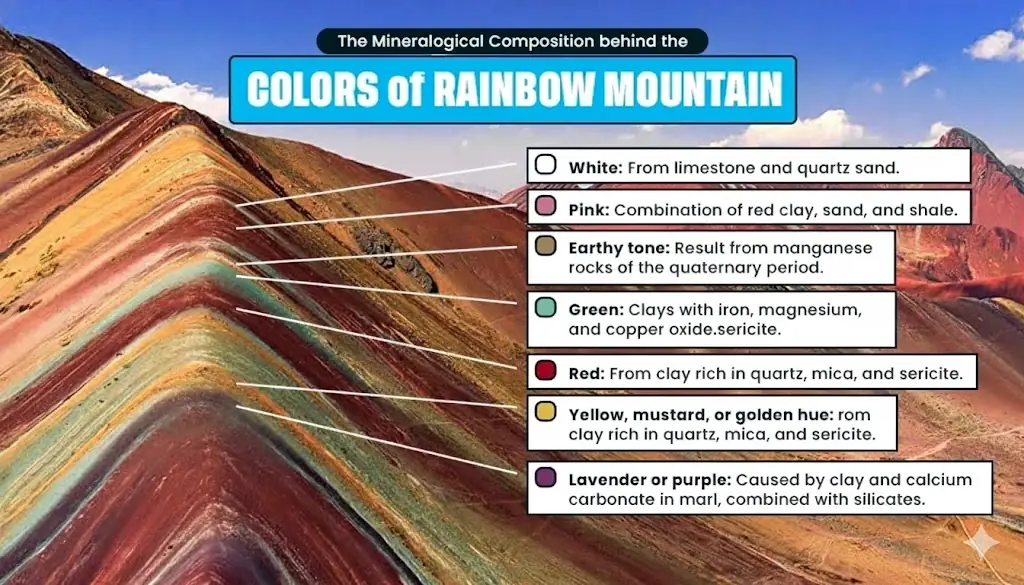
Colours of Rainbow Mountain
Colour Variability: Weather’s Paintbrush
During the dry season (April–October), clear skies and intense sunlight enhance the contrast between the colour bands. Daytime temperatures range between 10 °C and 15 °C, but nights can dip to −5 °C, so travellers often experience frost at dawn.
In the rainy season (November–March), heavier cloud cover and precipitation can make the path muddy and obscure the mountain; however, moisture intensifies the pigments, creating deeper reds and greens.
This is also when the Red River near Palccoyo turns a striking scarlet due to iron oxide sediments mixing with rainfall. Ultimately, there is no ‘bad’ time to see Rainbow Mountain-only different moods and photographic opportunities.
History and Cultural Significance
From Obscurity to Instagram Fame
For centuries, Rainbow Mountain was simply part of the landscape for local shepherds who grazed llamas, alpacas and vicuñas on its slopes. The Quechua name “Vinicunca” roughly translates to “coloured hill.” Because the peak was covered by snow and glaciers, its vibrant layers were known mainly through small exposed outcrops.
As global temperatures rose, the glaciers receded, and by around 2015 the mountain’s colours were fully revealed. Photographs quickly spread across social media, drawing thousands of visitors. The sudden influx brought economic opportunities but also pressures on the fragile ecosystem.
Pachamama and the Apus: Spiritual Framework
To understand the mountain’s cultural importance, we must appreciate the Andean cosmology. In Quechua belief, Pachamama is the embodiment of Mother Earth-the giver of life and sustenance. High peaks such as Ausangate are considered Apus, powerful deities who watch over the valleys.
Before festivals and important moments, communities perform rituals to honour Pachamama and the Apus. During the Cusco Carnival, for example, villagers gather to offer coca leaves, chicha (a fermented maize drink) and flowers to express gratitude for the harvest and ask for prosperity. These ceremonies often take place near sacred mountains, including Rainbow Mountain, reinforcing the bond between agriculture and the environment.
Visitors may witness Kintu rituals, in which a bundle of three coca leaves is held and prayerfully blown towards the mountains. Accepting coca leaves or chicha from a local is a sign of respect; travellers should reciprocate politely and drink or chew modestly. Avoid discarding coca leaves casually, as they are sacred. Learning a few Quechua words-rimaykullayki (hello), sulpayki (thank you)-shows respect.
Tourism, Livelihoods and Preservation
The rise in visitor numbers has transformed the economies of small Andean communities. Families that once relied solely on herding now offer horseback rentals, sell snacks and textiles, or act as porters and cooks for trekking companies. However, heavy foot traffic can damage fragile soils and disturb wildlife.
The Salkantay Trekking website reminds visitors that “touching the mountain is not allowed” because oils from human hands can erode the mineral surfaces. Staying on designated paths prevents erosion and preserves the Red Valley. Sustainable operators like Alpaca Expeditions limit group sizes, encourage alternative routes and reinvest profits into community projects.
Choosing the Best Time to Visit
Seasonal Weather Patterns
Peru’s high Andes experience two primary seasons:
- Dry season (April–October): Days are sunny with chilly mornings and evenings. Temperatures at Rainbow Mountain range between 10 °C and 15 °C, but wind chill can make it feel colder. Skies are clear, offering unobstructed views and making the trails firmer. This is peak tourist season, particularly June–August when European and North American summer holidays occur.
- Rainy season (November–March): Expect morning and afternoon showers, cloudy skies and occasional snow. Trails can be muddy and slippery. Colours appear saturated due to moisture, and there are fewer visitors. The Red River phenomenon near Palccoyo often occurs after heavy rainfall when iron‑rich sediments wash into the stream. Note that January and February often see the heaviest rainfall, and some trails may close temporarily.
Crowd Management
Rainbow Mountain’s popularity means the trail can become congested, especially between 09:00 and 12:00 when many tours arrive. To enjoy a more tranquil experience, consider:
- Early departures: Some operators begin pick‑ups at 02:00–03:00 am, allowing hikers to reach the summit by sunrise.
- Shoulder months: Visiting in April, May or September often provides good weather with fewer tourists. November and March are transitional months with moderate crowds.
- Alternatives: Hiking Palccoyo or Pallay Punchu offers similar views with fewer people. Multi‑day treks into Ausangate allow for sunrise visits before the day‑trip crowds arrive.
Routes to Rainbow Mountain
Getting There from Cusco
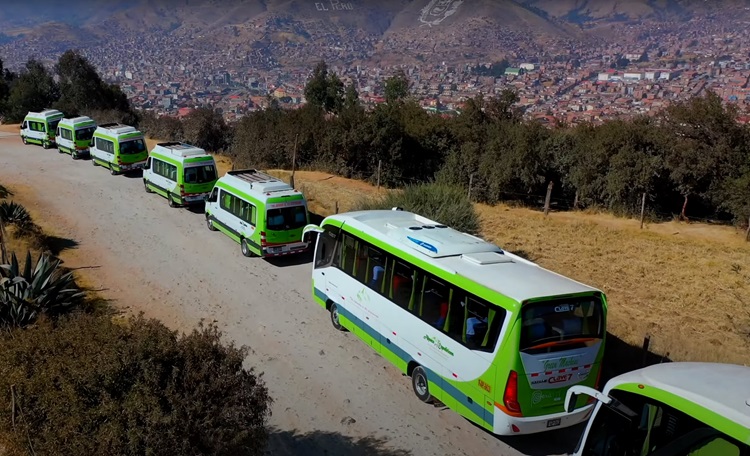
The journey begins with a road transfer from Cusco (3 400 m) to one of several trailheads. Most tours depart around 4 am and drive 3–3.5 hours southeast via the Interoceanic Highway. After a breakfast stop in a local village, the route diverges depending on the trail:
- Cusipata Route: The road continues through Cusipata to Chiri (also spelled Chilliwani) at roughly 4 630 m. This is currently the most popular starting point because of its shorter hike and better road conditions.
- Pitumarca Route: The road heads toward Checacupe then along the Pitumarca Valley. The trailhead near Pampachiri involves a longer hike but offers fewer crowds and the chance to extend into the Red Valley.
- Alternative roads: For Palccoyo and Pallay Punchu, the road continues south to Sicuani or Layo.
Cusipata Route-Step by Step
- Trailhead to Base Camp (0.5 km)-Starting at Chiri (4 630 m), the first section is a gentle ascent along a wide dirt path. You will see corrals with llamas and alpacas and small huts selling snacks. It typically takes 30 minutes to reach the base where horse handlers wait.
- Gradual Climb to Pass (2 km)-The path steepens as you climb toward the ridge. Colourful streaks appear on nearby hills. Rest stops are marked every few hundred metres. Hiking time is 1–1.5 hours depending on fitness.
- Final Ascent to Summit (0.75 km)-From the pass, the trail switchbacks up a steeper slope to a viewpoint at 5 200 m. Oxygen levels drop; pace yourself. On clear days you see the Ausangate glacier to the east. Total ascent time is roughly 2 hours.
- Descent & Optional Red Valley-Return along the same path (1–1.5 hours). For an extra fee, you can detour through the Red Valley via a loop trail (adds 1 hour). The valley’s iron‑rich soil glows rust‑red in sunlight.
Pros and Cons
- Pros: Shorter hike (approx. 3.5 km round trip); wide trail; many services (toilets, horses, snack stalls); accessible to most levels of fitness.
- Cons: Crowd levels are high; parking area can be chaotic; some sections can be dusty due to foot and horse traffic.
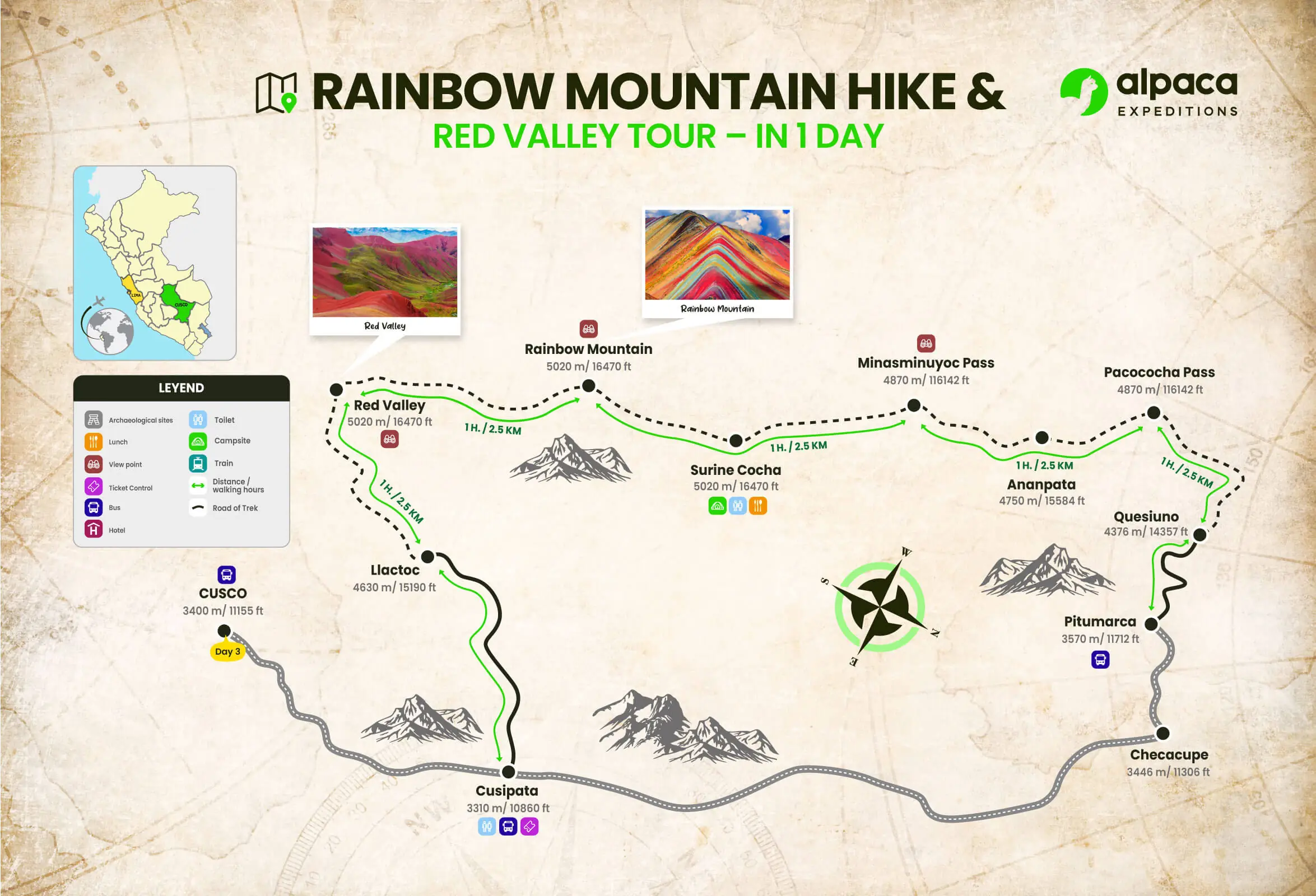
Routes to Rainbow Mountain
Pitumarca Route-Step by Step
- Trailhead at Pampachiri (4 500 m)-The walk begins in the Quesiuno community after the Pitumarca road ends. The first portion follows a valley with a gentle incline.
- Longer Approach (4–5 km)-The trail winds between rolling hills with vistas of Ausangate. Fewer tourists mean a quieter experience. Expect 2-2.5 hours to reach the base of the coloured ridge.
- Steep Final Climb (0.5 km)-A steeper path leads to the viewpoint. The altitude gain may feel more challenging due to the cumulative ascent.
Pros and Cons
- Pros: Fewer crowds; more scenic valley; opportunities to combine with Red Valley or Ausangate; communities benefit from tourism.
- Cons: Longer hiking distance (approx. 10 km round trip); less infrastructure; the road to the trailhead can be rough.
Ausangate & Red Valley Treks
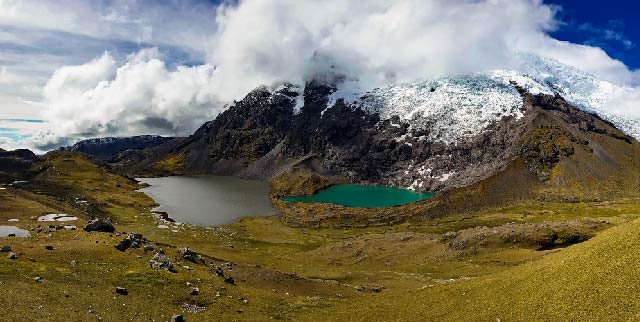
For serious trekkers, multi‑day circuits around Ausangate (6 384 m) allow you to explore turquoise glacial lakes, hot springs and remote Andean villages. Itineraries range from 3 to 6 days and include crossing high passes above 5 000 m. Rainbow Mountain is visited on day 2 or 3. Proper acclimatisation and good physical condition are essential.
Alternative Rainbow Mountains
Palccoyo
Located about 20 km south of Vinicunca, Palccoyo comprises three smaller rainbow mountains at a lower altitude (around 4 900 m). The hike is 1 km along a mostly flat path, making it suitable for families, older travellers and those sensitive to altitude.
Additional attractions include a stone forest of sharp rock spires and panoramic views of the surrounding range. Because the trail is easy, tours typically depart later in the morning and return by mid‑afternoon.
Pallay Punchu
Pallay Punchu (also known as Pallay Poncho) sits near the town of Layo by Langui Lagoon. It resembles a woven Andean poncho with jagged ridges and multicoloured streaks. At 4 700 m, the hike is a moderate 3 km round trip, ascending steeply for 45 minutes before traversing along the crest.
Due to its recent discovery in 2020, crowd levels remain low. The landscape is rugged and photographic; you may see herds of llamas and alpacas grazing freely.
Comparison Table
| Mountain | Altitude | Hike Distance/Time | Difficulty | Highlights | Crowd Level |
| Vinicunca (Rainbow Mountain) | ~5 200 m | 3.5 km (Cusipata) / 10 km (Pitumarca), 1.5–3 h | Moderate (high altitude) | Bold colour bands, Ausangate views | High |
| Palccoyo | 4 900 m | 1 km, 30–45 min | Easy | Three rainbow mountains, stone forest, Red River in rainy season | Low |
| Pallay Punchu | 4 700 m | 3 km, 2 h | Moderate | Jagged “poncho” ridge, views of Langui Lagoon | Low |
Self‑Guided vs. Guided Tours
While it is technically possible to rent a car and self‑navigate to the trailheads, most travellers opt for a guided tour for convenience and safety. Guides provide transportation, meals, entrance fees, horses (for an extra cost), oxygen and first aid. They also act as cultural interpreters, explaining local customs and ensuring compliance with porter laws. If you drive yourself, be prepared for high‑altitude dirt roads, minimal signage and limited parking. Always inform local authorities of your plans and carry extra fuel, water and snacks.
Preparing for High Altitude
Why Altitude Matters
As you climb above 3 000 m, the partial pressure of oxygen decreases. At 3 050 m the inspired oxygen pressure is only 69 % of sea level. At Rainbow Mountain’s 5 200 m, oxygen availability drops even further, significantly challenging those unaccustomed to such heights. The body’s immediate response is increased breathing and heart rate; over days, it produces more red blood cells and undergoes fluid adjustments.
Symptoms of Altitude Illness
Acute Mountain Sickness (AMS) is the most common form of altitude illness. It affects up to 25 % of people sleeping above 2 450 m. Symptoms resemble a hangover-headache, loss of appetite, nausea or vomiting, dizziness, fatigue and difficulty sleeping. Symptoms usually develop 2–12 hours after ascent and resolve within 12–48 hours if no further ascent occurs. Children may become irritable or lose their appetite.
More serious conditions include:
- High‑Altitude Cerebral Edema (HACE): Symptoms include confusion, ataxia (loss of coordination) and extreme drowsiness. Without treatment and descent, coma can occur within 24 hours.
- High‑Altitude Pulmonary Edema (HAPE): Presents with chest congestion, persistent cough, shortness of breath at rest and sometimes frothy or bloody sputum. It can progress rapidly and is potentially fatal if not treated with oxygen and descent.
Prevention and Acclimatisation Plan
The best way to prevent altitude illness is to ascend gradually and allow your body time to acclimatise. The CDC recommends spending 2–3 nights at elevations of 2 450–2 750 m before going higher. Once above 3 000 m, increase sleeping altitude by no more than 500 m per day and take an extra rest day for every 1 000 m gained. For Rainbow Mountain, this means spending at least two nights in Cusco (3 400 m) before the hike.
Sample Acclimatisation Schedule
- Day 1: Arrive in Lima (sea level); overnight or fly directly to Cusco. Limit exertion; hydrate.
- Day 2: Explore Cusco lightly-visit local markets, Sacsayhuamán ruins; avoid alcohol; drink coca tea.
- Day 3: Day trip to Sacred Valley (Pisac, Ollantaytambo-2 700 m) to sleep at a slightly lower altitude.
- Day 4: Hike Humantay Lake (4 200 m) or take a city tour to further adapt.
- Day 5: Rainbow Mountain day trip.
Additional Tips
- Hydration: Drink 2–3 litres of water per day. Dry air at altitude increases fluid loss.
- Nutrition: Eat light, high‑carb meals for energy; avoid heavy, fatty foods that slow digestion.
- Rest days: Plan a rest day after every 3–4 days at high altitude.
- Avoid alcohol and smoking: They interfere with acclimatisation and increase dehydration.
- Medication: Consult a doctor about acetazolamide (125 mg twice daily starting 24 h before ascent). It speeds acclimatisation by increasing breathing and thus oxygen levels. Side effects can include tingling fingers or altered taste. Ibuprofen or paracetamol can alleviate headaches. Dexamethasone is reserved for treatment of severe AMS and HACE.
- Coca tea and leaves: Locals drink mate de coca to ease mild symptoms and chew coca leaves. While coca is legal in Peru, travellers should not transport coca products back to their home countries.
- Portable oxygen: Some tours carry oxygen cylinders; you may also rent small portable units. Remember that compressed cans provide only limited relief.
What to Do if You Experience Symptoms
If you experience mild AMS symptoms, stop ascending and rest at the same altitude. Inform your guide or companion and avoid exertion. Symptoms often improve within 24–48 hours. Continue to drink water and eat light meals. Over‑the‑counter anti‑nausea medicines and painkillers can provide relief
Three golden rules to prevent severe consequences:
- Acknowledge early symptoms: Do not ignore headaches, nausea or dizziness.
- Do not ascend with symptoms: Never sleep at a higher altitude if you feel unwell.
- Descend if symptoms worsen: If rest and treatment do not improve symptoms or you develop confusion, ataxia or breathlessness, descend at least 300–1 000 m immediately.
Seek medical help or oxygen therapy. Evacuation may require contacting a rescue service or riding a horse back to the trailhead.
Essential Packing List & Gear Guide
Clothing & Accessories
The key to comfort on Rainbow Mountain is layering. Temperatures can shift from freezing pre‑dawn conditions to intense midday sun in a matter of hours. A good system includes:
- Base layer: Moisture‑wicking long‑sleeved top and thermal leggings (merino or synthetic). Avoid cotton as it retains sweat.
- Mid‑layer: Fleece or lightweight down jacket. A soft‑shell jacket adds warmth and wind resistance.
- Outer shell: Waterproof and breathable jacket and trousers; a poncho is useful in heavy rain. Even in the dry season, sudden hail or snowstorms can occur.
- Legwear: Convertible hiking pants; avoid jeans. Add thermal leggings if you get cold easily.
- Footwear: Waterproof hiking boots with ankle support and a grippy outsole. Break them in before hiking to prevent blisters. Bring moisture‑wicking socks and spare pairs.
- Head & hands: Warm hat (beanie) for morning, wide‑brimmed sun hat or cap for midday, neck buff or scarf, and gloves. The sun at 5 000 m is intense, and frostbite is possible in winter.
- Eyewear & sun protection: Sunglasses with UV400 rating; high‑SPF sunscreen (50+); SPF lip balm. UV radiation is strong at altitude even on cloudy days.
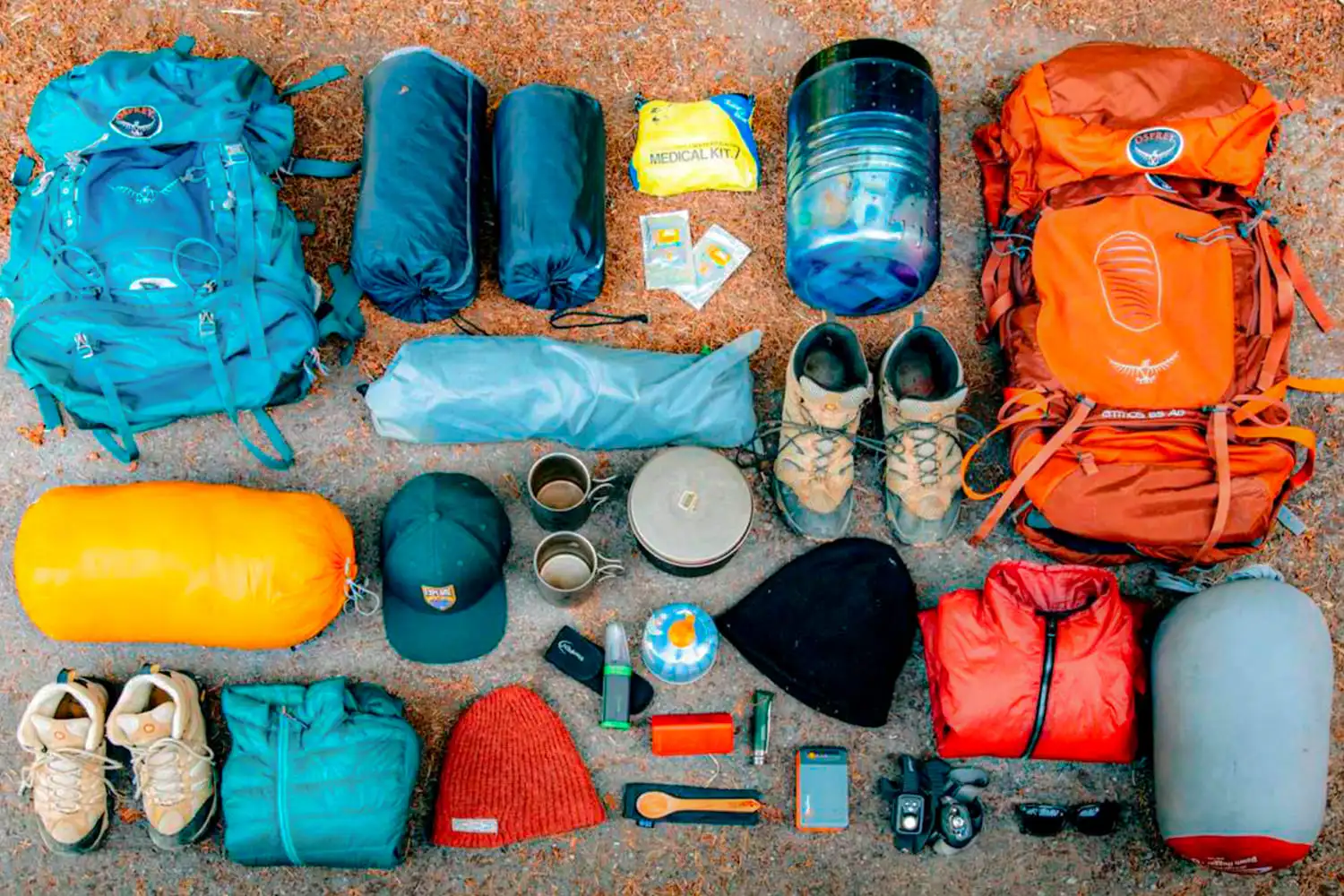
Essential Packing List & Gear Guide
Equipment & Supplies
- Backpack: 20–30 L daypack with padded straps and hip belt. Include a rain cover.
- Hydration: Carry at least 2 L of water. A hydration bladder allows you to sip continuously. Use purification tablets or filters if refilling from streams.
- Trekking poles: Adjustable poles reduce impact on knees during ascents and descents and provide stability on uneven terrain.
- Snacks: High‑energy, easy‑to‑digest foods (nuts, dried fruit, energy bars, chocolate). Avoid heavy, greasy snacks at altitude.
- First‑aid kit: Include blister plasters, bandages, antiseptic wipes, painkillers, anti‑diarrhoea tablets, altitude medication, throat lozenges and any personal prescriptions. Add a space blanket for emergency warmth.
- Electronics: Fully charged camera or smartphone; spare batteries (cold drains power quickly); portable power bank. Headlamp or flashlight for early starts.
- Documents & money: Copy of passport, tourist card, travel insurance, cash in small denominations (20–50 soles), credit card. Keep valuables in a waterproof pouch.
- Other essentials: Toilet paper, hand sanitiser, lightweight towel or wipes, sealable bags for rubbish, reusable cutlery and cup, personal hygiene products, reusable straw.
Printable Packing Checklist
| Item | Quantity | Tick |
| Moisture‑wicking base layers (top & bottom) | 1–2 | ☐ |
| Fleece or down mid‑layer | 1 | ☐ |
| Waterproof jacket | 1 | ☐ |
| Waterproof pants or poncho | 1 | ☐ |
| Hiking pants | 1–2 | ☐ |
| Thermal leggings | 1 | ☐ |
| Waterproof hiking boots | 1 pair | ☐ |
| Hiking socks | 2–3 pairs | ☐ |
| Warm hat, sun hat, buff | 1 each | ☐ |
| Gloves | 1 pair | ☐ |
| Sunglasses (UV400) | 1 | ☐ |
| Sunscreen (SPF 50+) | 1 | ☐ |
| Lip balm (SPF) | 1 | ☐ |
| Daypack (20–30 L) | 1 | ☐ |
| Rain cover | 1 | ☐ |
| Hydration bladder or bottles (2 L) | 1 | ☐ |
| Trekking poles | 2 | ☐ |
| Snacks | As needed | ☐ |
| First‑aid kit & medication | 1 | ☐ |
| Camera/phone & chargers | 1 | ☐ |
| Portable power bank | 1 | ☐ |
| Headlamp | 1 | ☐ |
| Passport copy & tourist card | 1 | ☐ |
| Cash (soles) & credit card | — | ☐ |
| Toilet paper & hand sanitiser | — | ☐ |
| Rubbish bags | — | ☐ |
| Optional: Gaiters, down jacket, hand warmers | — | ☐ |
What Not to Bring
- Single‑use plastics: Peru is phasing out plastic bags. Bring reusable containers and bottles. Use water filters or boiled water rather than buying bottled water.
- Large suitcases: Leave them in Cusco; only bring what you need for the hike. Overpacking burdens porters and horses.
- Excessive electronics or jewellery: Valuables may be lost or damaged; keep it simple and secure.
- Shorts and sleeveless shirts: Exposed skin burns easily at altitude. Opt for lightweight long sleeves and pants.
Detailed Itineraries
Day Trip from Cusco (Standard Rainbow Mountain Tour)
The classic Rainbow Mountain tour fits comfortably into a single day, provided you have already acclimatised in Cusco. A typical itinerary looks like this:
- 02:30–04:00 am-Early pick‑up: Guides collect participants from hotels. Many travellers sleep in the van.
- 04:00–06:00 am-Drive to trailhead: The route to Cusipata includes a stop in a local village for a hearty breakfast (usually quinoa porridge, eggs, bread and coca tea) and to buy snacks and rent trekking poles.
- 06:30–07:00 am-Arrival at Chiri: Stretch, apply sunscreen and adjust clothing layers. Your guide will brief the group on the hike, safety and acclimatisation.
- 07:00–09:30 am-Hike to summit: Ascend gradually, stopping to drink water and catch your breath. Horse rentals are available for those struggling (pay directly to the local handler; weight limit around 80 kg to protect animals). Guides frequently check participants for signs of AMS and carry supplemental oxygen.
- 09:30–10:30 am-Viewpoint: Celebrate your arrival at 5 200 m! Take photos with rainbow flags (for a small tip), gaze at the Ausangate glacier, and optionally walk to a higher ridge (adds 10 min) for a panoramic view. Do not litter or remove rocks; leave offerings only if accompanied by a guide.
- 10:30–12:00 pm-Descent: Descend slowly; take care on gravel sections. Consider the optional Red Valley side trail (approx. 1 h extra) for dazzling red landscapes.
- 12:30–13:30 pm-Lunch: Return to the bus and drive to a local restaurant for a buffet lunch (soup, rice, grilled chicken or alpaca, vegetables, tea). Supporting locally owned eateries keeps money in the community.
- 13:30–16:30 pm-Return to Cusco: Nap or watch the scenery. Drop off at hotels by 4 pm or 5 pm.
Tips for Success:
- Dress warmly but in layers; mornings are cold and afternoons warm.
- Use trekking poles on descents to protect knees.
- Carry small bills to pay for restrooms, horse rentals and souvenirs.
- Respect local customs; ask before photographing people or animals.
Two‑Day Rainbow Mountain & Red Valley Camping Tour
For travellers who want to beat the crowds and experience sunrise over the Andes, a two‑day itinerary provides a richer experience:
Day 1:
- Depart Cusco mid‑morning and drive to Quesiuno trailhead (Pitumarca route). Hike 3–4 hours to a high‑altitude campsite near Anantapata. En route, pass shepherds and herds of vicuñas. Learn about medicinal plants and Quechua traditions from your guide. After a hearty dinner, gaze at a sky full of stars; the thin air and lack of light pollution make constellations vivid.
Day 2:
- Wake at 04:30 am, enjoy coca tea and breakfast, then hike 45 minutes to a sunrise viewpoint of Rainbow Mountain. Arriving before the day‑trip visitors allows you to savour the solitude. After taking photos, continue down through Red Valley, where iron‑rich soil colours the entire valley floor red. Descend to the trailhead, lunch, and return to Cusco.
Benefits: Additional acclimatisation, fewer crowds, deeper cultural immersion, and time to explore the Red Valley thoroughly. Note: camping equipment, porters and cooks are supplied by reputable tour operators; choose those who adhere to porter weight limits.
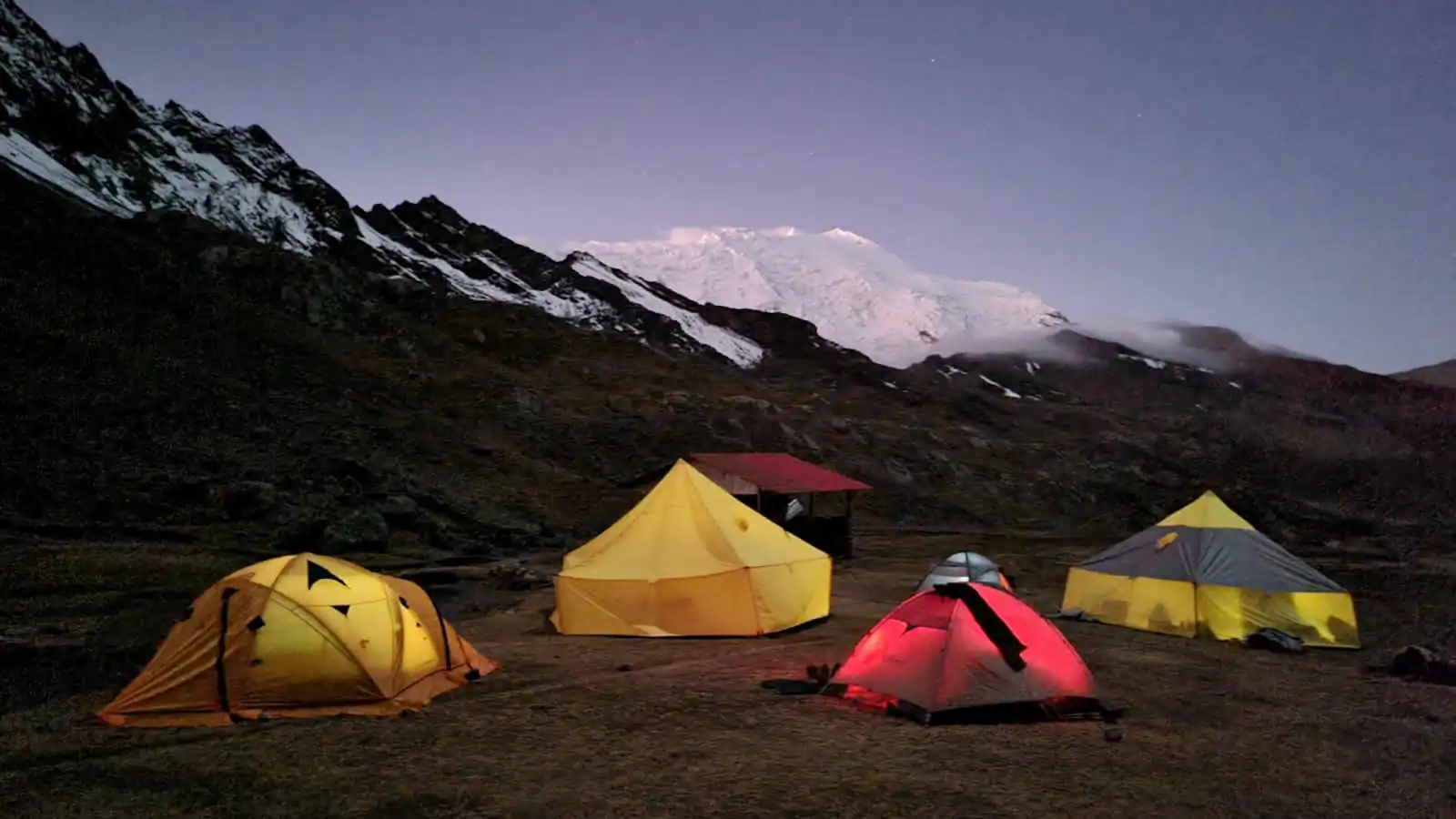
Rainbow Mountain Uncensored – Camping Tour
Multi‑Day Ausangate & Rainbow Mountain Trek
The Ausangate circuit is a high‑altitude odyssey that circumnavigates one of Peru’s sacred mountains. Several itineraries exist; here is a 5‑day example:
Day 1-Cusco to Upis: Drive to Tinki (3 800 m), begin trekking through puna grasslands to the community of Upis. Soak in natural hot springs beneath Ausangate.
Day 2-Upis to Pucacocha: Cross the Arapa Pass (4 850 m); pass turquoise lakes and camp at Pucacocha amid glacial moraine.
Day 3-Pucacocha to Anantapata: Cross the Pucacocha Pass with views of red and purple striped hills. Camp near Anantapata; optionally climb a ridge to view the coloured mountains from afar.
Day 4-Anantapata to Rainbow Mountain: Hike to Warmisaya Pass, then detour to Rainbow Mountain via the Pitumarca trail. Enjoy the summit without day‑trip crowds, descend to Llamachimpana. Continue through Red Valley. Camp near Qampa.
Day 5-Qampa to Pacchanta and Cusco: Cross Qampa Pass, visit glacial lakes and descend to Pacchanta where you can soak in hot springs. Drive back to Cusco.
This trek reaches altitudes above 5 200 m multiple times, so excellent acclimatisation and fitness are required. It offers remote wilderness, abundant wildlife and an intimate connection to Andean culture. Selecting a responsible operator ensures porters are fairly treated and the environment respected.
Combining Rainbow Mountain with Other Attractions
- Humantay Lake + Rainbow Mountain: Over two days you can visit Humantay Lake (a turquoise glacial lagoon at 4 200 m on the Salkantay trek) on day 1 and Rainbow Mountain on day 2. Suitable for those with limited time who want two iconic Andean landscapes.
- Salkantay Trek + Rainbow Mountain: An extended 7‑day trek that includes the Salkantay Pass (4 600 m), Machu Picchu and a Rainbow Mountain side trip. This route requires good fitness but showcases diverse ecosystems from cloud forest to high alpine.
- Sacred Valley + Rainbow Mountain: Many travellers explore the Sacred Valley (Pisac, Moray, Maras, Ollantaytambo) then dedicate a day to Rainbow Mountain. It’s possible to book a combined package that includes transfers and guides for both areas.
Itineraries for Alternative Mountains
Palccoyo Day Trip:
- 06:00 am: Departure from Cusco; breakfast en route.
- 09:00 am: Arrive at trailhead near Palccoyo; gentle 30‑minute walk to first viewpoint. Explore stone forest; optional short hikes to other coloured hills. Enjoy panoramic photo stops.
- 11:30 am: Return to vehicle; stop for lunch in local village.
- 15:00 pm: Arrive back in Cusco.
Pallay Punchu Day Trip:
- 03:00 am: Early departure; long drive to Layo near Langui Lagoon.
- 07:00 am: Begin hike; steep ascent for 45 minutes to the ridge; explore jagged “poncho” formations and view across the lagoon.
- 10:00 am: Descend; lunch with local community. Short visit to Sicuani for traditional dishes such as pachamanca (meat and vegetables cooked in an earth oven).
- 17:00 pm: Return to Cusco.
Each of these itineraries emphasises leaving early, hydrating well and spending time acclimatising.
Responsible & Sustainable Tourism
Porter Welfare & Peru’s Porter Law
Porters are the backbone of trekking in Peru. Without them, carrying camping equipment, food and supplies to high altitudes would be nearly impossible. Yet for years porters were paid low wages and carried heavy loads. In 2022, Peru enacted Law No. 31624, known as the Porter Law, to protect these workers. Key provisions include:
- Minimum age: Porters must be at least 18 years
- Maximum load: Male porters may carry 20 kg and female porters 15 kg. Loads are weighed before departure.
- Working hours: Limited to a maximum of 48 hours per week with five days of rest between shifts.
- Nutrition & equipment: Tour operators must provide nutritious meals, appropriate clothing and lumbar support belts. Overnight stays must be in sheltered environments, not in the open.
- Insurance & salary: Porters must receive supplementary insurance covering accidents. Pay must be at least 3 % of Peru’s tax unit per day (around 138 soles/day) with a 30 % bonus if they also cook.
When choosing a trekking company, ask how they comply with this law. Support operators who employ porters from local communities, offer training and provide benefits such as education funds for porter families. Avoid over‑loading porters or demanding extra services without compensation. Be mindful of your own luggage weight; pack only what you need.
Environmental Stewardship
The colourful layers of Rainbow Mountain are fragile. Oils from human skin can degrade the minerals, and foot traffic damages the thin alpine vegetation. To minimise impact:
- Stay on marked trails: Trails are designed to concentrate foot traffic and reduce erosion. Venturing off‑trail kills plants and destabilises slopes.
- Pack out your rubbish: Bring a small bag to carry used tissues, snack wrappers and other waste. Do not leave anything behind.
- Use reusable bottles: Avoid buying single‑use water bottles. Fill your bottle in Cusco or use a filter or boiled water during multi‑day treks.
- Respect wildlife: Keep a safe distance from llamas, alpacas and vicuñas. Do not chase, feed or touch them. Livestock are working animals; ensure children do not treat them like pets.
- Limit group size: Travel in small groups (≤ 12 people) to reduce noise and environmental pressure. Operators like Alpaca Expeditions maintain small group policies.
- Avoid drones: Drones can disturb wildlife and local rituals. Many communities prohibit them without special permission.
Cultural Respect
- Ask before photographing: Always ask permission before taking photos of people, especially elderly locals. Offer a small tip if they agree.
- Learn basic Quechua: Simple phrases show respect and break down barriers. For example, Allianchu (How are you?), Sulpayki (Thank you), Tupananchiskama (See you later).
- Participate mindfully: If invited to join a ritual, watch and follow the lead of the elders. Do not take items from the offering. Accept coca leaves or chicha graciously.
- Support local economies: Buy textiles directly from artisans; choose community‑run accommodations; tip guides, cooks and porters fairly.
Culture & Local Experiences
Quechua Language & Etiquette
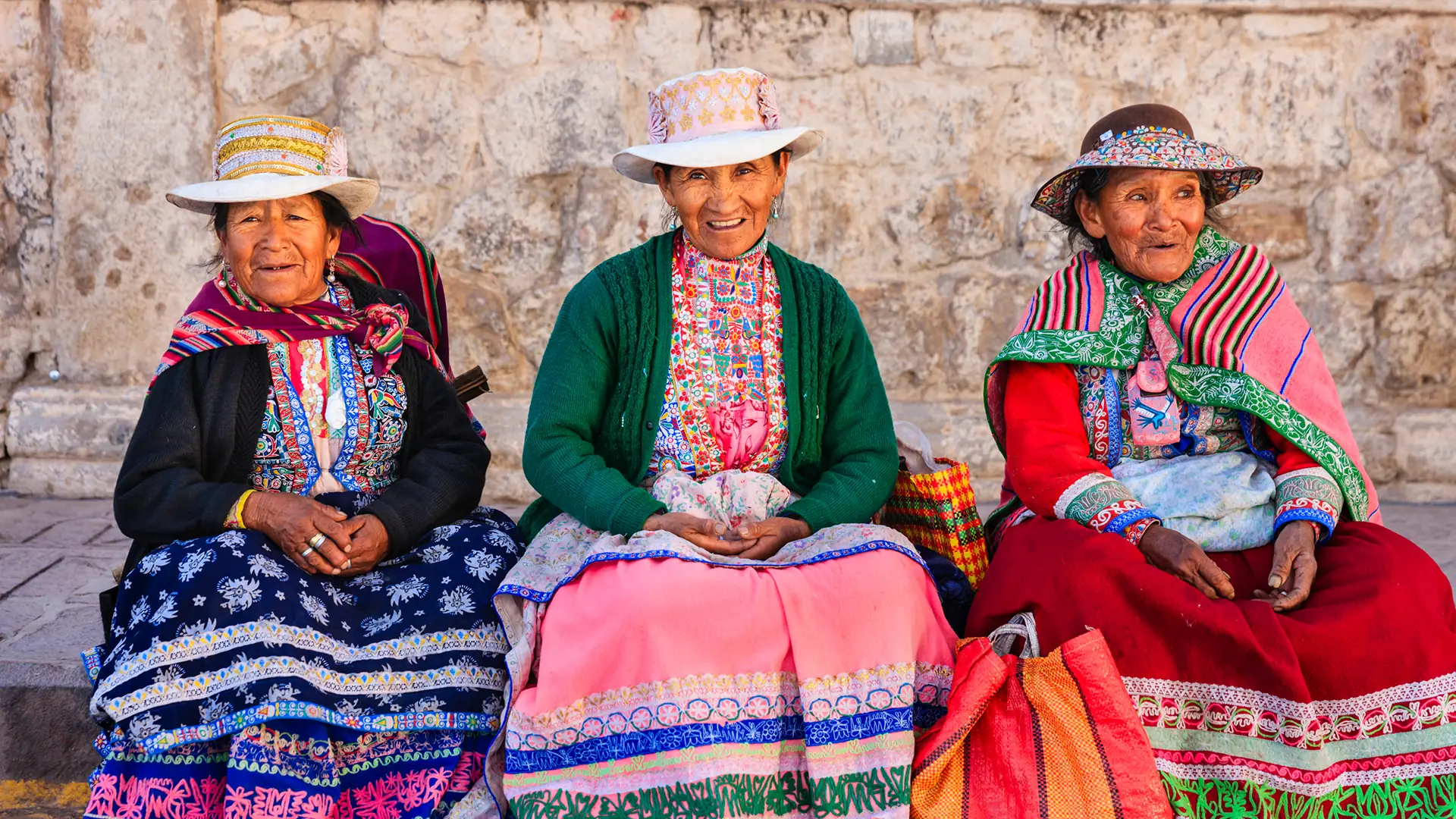
Culture & Local Experiences
Quechua is the most widely spoken Indigenous language in Peru. Learning a few phrases enriches your experience and demonstrates respect. Pronunciation emphasises vowels; say words slowly and clearly.
- Rimaykullayki: Hello (formal)
- Imaynalla: How are you?
- Sulpayki: Thank you
- Ari: Yes
- Mana: No
- Tupananchiskama: Until we meet again
When greeting elders, slightly bow your head. Avoid pointing directly at people; use an open hand. Hand‑shaking is common in markets; hug lightly only if invited.
Food & Drink
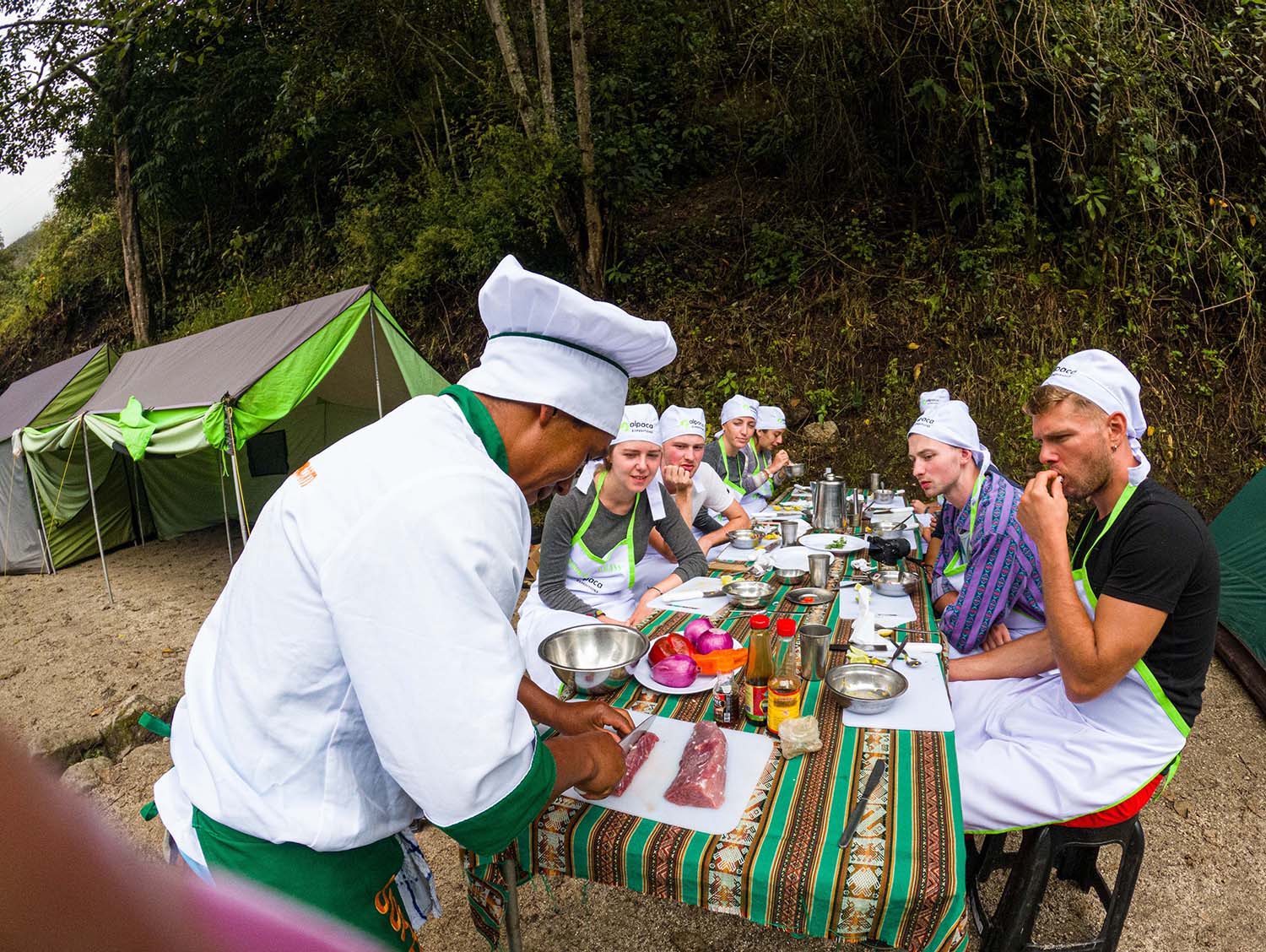
The Andean diet is hearty and nutritious, tailored to life at high altitudes. During tours you might taste:
- Quinoa soup: A warm broth with vegetables and Andean grains.
- Trucha (trout): Freshly caught from highland streams, often grilled or fried.
- Alpaca steak: Lean and tender, served with potatoes and salad.
- Pachamanca: Meat and vegetables (usually chicken, pork, potatoes, beans) cooked in an earthen oven heated with hot stones; often prepared during festivals.
- Choclo con queso: Large‑kernel corn served with a slice of local cheese.
- Chicha: Fermented corn drink; often lightly alcoholic. Visitors may be offered chicha de jora (yellow, fermented) or chicha morada (sweet purple corn drink).
- Coca tea: Herbal infusion from coca leaves; helps with mild altitude discomfort. Do not bring coca products back to the USA or UK.
Festivals & Events
Cusco Carnival (February): A lively event blending Andean and Spanish traditions. Key elements include the Comparsas (parade of dancers), Yunza (tree decorated with gifts, chopped during the party) and rituals to Pachamama.
Participants spray each other with foam and coloured powder. If visiting during carnival, pack clothes you don’t mind getting dirty. The festival underscores gratitude for harvest and fertility.
Inti Raymi (June 24): Reenactment of the Inca sun festival at Sacsayhuamán; features dancers, musicians and actors portraying Inca nobility. Tickets sell out early.
Pachamama Day (August 1): Communities perform Pago a la Tierra (payment to the earth) by burying offerings of coca leaves, sweets, cereals and wine in a small pit near a sacred mountain or household farm. The ceremony thanks Mother Earth and seeks blessings for the coming year.
Qoyllur Rit’i Pilgrimage (May/June): Thousands of pilgrims trek to the Sinakara glacial valley near Ausangate to honour the Lord of the Snow Star. The event combines Catholic and Andean beliefs, culminating in dances and rituals at 4 800 m.
Handicrafts & Souvenirs
Cusco and the villages around Rainbow Mountain offer beautiful handicrafts. To ensure authenticity and support artisans:
- Textiles: Look for handwoven alpaca or sheep wool scarves, ponchos, hats and blankets. Genuine alpaca is soft and warm; acrylic blends are cheaper and less insulating.
- Chullo hats: Colourful knitted hats with ear flaps are iconic in the Andes. Purchase them directly from women knitting by the roadside or in cooperatives.
- Ceramics: Pisac and Raqchi artisans produce pottery decorated with Inca motifs and local flora.
- Silver jewellery: Peru is known for fine silverwork; designs often incorporate Inca symbols like the Andean cross (Chakana).
- Musical instruments: Small panpipes (zampoñas) and ocarinas make unique souvenirs.
Avoid items made from endangered species (such as condor feathers) or ancient artefacts. Always ask whether materials are ethically sourced.
Practical Travel Information for USA & UK Travellers
Flights & Getting There
From the United States: Major airlines operate daily flights to Lima (Jorge Chávez International Airport) from hubs such as Miami, Dallas, Atlanta, Houston, Los Angeles and New York.
Flight time is roughly 6–8 hours depending on departure city. From Lima, connect on a domestic carrier to Cusco (Alejandro Velasco Astete Airport); the flight takes about 1 hour 20 minutes. Factor in at least two hours for customs and luggage transfer in Lima.
From the United Kingdom: There are no direct flights from London to Lima, but carriers such as British Airways, KLM, Iberia and LATAM offer one‑stop journeys via Amsterdam, Madrid or São Paulo.
Total travel time ranges from 14 to 18 hours, plus the domestic flight to Cusco. Ensure you have at least a three‑hour layover to accommodate international‑domestic transfers in Lima.
Alternative routes: Travellers can also fly via Bogotá (Colombia) or Panama City (Copa Airlines) before connecting to Lima. Sometimes these routes offer cheaper fares. Always check entry requirements for transit countries.
Entry Requirements & Visas
Citizens of the USA and UK do not need a tourist visa to enter Peru for stays of up to 90 days. Upon arrival you will receive an Andean Immigration Card (sometimes digital), which you must keep until departure.
Passports should be valid for at least six months beyond your planned exit date. If you plan to volunteer or stay longer than 90 days, consult the Peruvian consulate for appropriate visas.
Health & Vaccinations
- Routine vaccinations: Ensure you are up to date with measles, mumps, rubella, tetanus, diphtheria and pertussis. Hepatitis A is recommended; typhoid for rural travel.
- Yellow fever: Required if travelling to the Amazon basin (e.g., Puerto Maldonado or Iquitos). Not needed for Cusco or Rainbow Mountain.
- COVID‑19: Follow the latest vaccination and testing requirements. Peru has lifted most restrictions, but airlines may have their own policies.
- Malaria: Not an issue in the Andean region but take prophylaxis if visiting the Amazon.
- Traveller’s diarrhoea: Carry rehydration salts and over‑the‑counter medicine; avoid uncooked food and tap water. “Cook it, peel it or forget it.”
Consult your GP or travel clinic at least six weeks before departure.
Currency, Budget & Payments
Peru’s currency is the Nuevo Sol (PEN). ATMs are widely available in Cusco, and most hotels and tourist restaurants accept credit cards. However, bring cash for entrance fees, souvenirs and tips, especially in rural areas. Exchange a small amount at the airport or withdraw from an ATM in Lima; avoid street money changers.
Typical costs:
- Rainbow Mountain day tour: USD 60–100 (varies by operator and inclusions). Always confirm what is included (meals, entrance fees, horses).
- Horse rental: ~50 soles one way (pay the handler directly).
- Entrance fee: ~10–20 soles at Vinicunca; included in most tours.
- Tips: 5–10 % for guides; 10–20 soles per porter or cook on multi‑day treks.
Insurance & Safety
High‑altitude trekking carries inherent risks, including falls, weather changes and altitude sickness. Purchase comprehensive travel insurance covering medical evacuation, trip cancellation, baggage loss and adventure activities. Keep emergency contacts handy:
- Peruvian emergency number: 105 (police), 106 (ambulance)
- Tourist Protection Network (IPERÚ): 24/7 assistance at 01‑574‑8000
- Alpaca Expeditions office: Provide contact once you book.
Register your travel with the US Smart Traveller Enrollment Program (STEP) or the UK FCDO Travel Aware service. Avoid carrying valuables in open view; use hotel safes. Cusco is generally safe, but pickpocketing occurs in crowded markets.
Frequently Asked Questions
- Why are the colours so vivid at Rainbow Mountain? The colours come from layers of sedimentary rock rich in minerals like iron oxide (red), copper and magnesium (green), calcium carbonate (white) and sulfurous minerals (yellow). Erosion and oxidation accentuate the hues.
- How high is Rainbow Mountain? The summit viewpoint sits around 5 200 m (17 060 ft). The hike begins at approximately 4 600 m.
- Do I need to be super fit? A reasonable level of fitness helps, but the main challenge is altitude rather than distance. Hikers regularly stop to catch their breath. Using horses for part of the ascent is possible but ensure the animals are treated well.
- How long does the hike take? The Cusipata route typically requires 1.5–2 hours to ascend and 1–1.5 hours to descend. The Pitumarca route is longer (4–5 h round trip).
- Can I visit Rainbow Mountain year‑round? Yes. Dry season offers clear skies; rainy season brings saturated colours and fewer visitors. Some trails may close briefly during heavy rain.
- Is altitude sickness common? Many visitors experience mild AMS symptoms such as headache and dizziness. Acclimatise for two days in Cusco, drink water and ascend slowly. Recognise the signs of severe illness (confusion, breathlessness) and descend immediately.
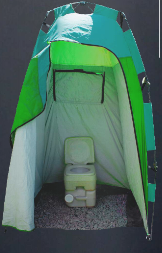
- Are there toilets on the trail? Basic toilets exist at the trailheads and halfway up. Bring your own toilet paper and hand sanitiser.
- Is it safe to drink the water? Do not drink stream water untreated. Bring a filter or purification tablets. Most tours provide boiled water.
- What should I wear? Layered clothing suitable for temperatures from −5 °C to 15 °C, waterproof jacket, sturdy boots, hat, gloves and sunglasses.
-
Can I rent a horse?
Yes, local handlers offer horses for around 50 soles one way. Weight limits apply (~80 kg). Even on a horse you must walk the final steep section.
- Are drones allowed? Drones are generally prohibited without special permission. They can disturb wildlife and local ceremonies.
- Is Rainbow Mountain suitable for children? Children over 10 who are physically active and acclimatised may manage the hike with frequent rests. For younger children, Palccoyo is a better option.
- What animals will I see? You will likely see llamas, alpacas and perhaps vicuñas. Birds include Andean condors, caracaras and hummingbirds. Do not feed wildlife.
- What is the entrance fee? The fee varies (around 10–20 soles). It’s often included in tour prices. Bring cash.
- Do I need permits? No special permits are required for day hikes. Multi‑day treks may require local permissions obtained by your tour operator.
- Is Rainbow Mountain wheelchair accessible? The steep, uneven trail and high altitude make wheelchair access extremely challenging. Palccoyo’s flat path might be more feasible with assistance.
- Are there ATMs near the trail? No. Withdraw cash in Cusco before departure.
- Is the trail safe for solo travellers? Solo travel is possible but not advised due to the risk of altitude illness and navigation challenges. Join a group for safety and local knowledge.
- Can I combine Rainbow Mountain with Machu Picchu in one day? Logistically challenging and not recommended; the sites are far apart. Plan at least two separate days.
- Are women travellers safe on the trek? Yes. Peru is generally safe for women travellers; however, join reputable tours and avoid hiking alone.
-
What is Palccoyo’s Red River?
During the rainy season, runoff carrying red sediment turns a nearby stream crimson. It’s an extraordinary sight lasting only after heavy rains.
- What altitude medication should I take? Speak to your doctor about acetazolamide. Dosage is typically 125 mg twice a day, beginning 24 h before ascent. Continue for 48 h after reaching high altitude.
- Are there hotels near Rainbow Mountain? There are basic homestays and lodges in villages like Pitumarca and Cusipata, but most travellers stay in Cusco.
- Is there mobile phone reception? Limited. Some areas near the trailhead have signal but expect poor connectivity on the hike.
- Can I camp near Rainbow Mountain? Camping is allowed only with organised tours on designated sites. Solo camping is discouraged due to cold, high winds and lack of facilities.
- What are the trail conditions? Dirt and gravel. During rain it becomes muddy; during dry weather it can be dusty. The final ascent is steep with loose rocks.
- How can I reduce my environmental footprint? Bring reusable bottles, stay on trails, pack out trash, avoid single‑use plastics, travel in small groups and choose operators that emphasise sustainability.
- What if I have dietary restrictions? Inform your tour operator in advance. Most can accommodate vegetarian, vegan or gluten‑free meals with local ingredients (quinoa, corn, potatoes).
- Can I visit Rainbow Mountain independently? Yes, but you need to arrange transport, entrance fees and food yourself. The roads are rough and navigation tricky. Hiring a trusted driver is recommended.
- Does Rainbow Mountain ever close? Rarely. Heavy snow or landslides can temporarily close the trail for safety; check with local authorities or tour operators.
- Are there any cultural taboos I should be aware of? Do not touch the coloured slopes or remove rocksDo not urinate on sacred sites. Always show respect during rituals and avoid loud music.
-
How should I tip porters and guides?
For a day trip, tip 10–20 soles per guide. For multi‑day treks, allocate 60–80 soles total per porter and 100–150 soles for guides, depending on service quality and group size.
- What’s the best way to photograph Rainbow Mountain? Bring a wide‑angle lens for panoramas and a zoom lens to capture details. Sunrise offers soft lighting; midday emphasises colour contrast. Use polarising filters to reduce glare. Respect other hikers when positioning your tripod.
- Can I bring my drone to Rainbow Mountain? Generally no without a permit. Local authorities may confiscate drones flown without authorisation.
- Is Rainbow Mountain dog‑friendly? Pets are not permitted on group tours. The altitude and long transport make it unsuitable for most animals.
- What other coloured mountains are there in Peru? The Ausangate region features numerous smaller colourful hills. Vinicunca, Palccoyo and Pallay Punchu are the most famous accessible ones. Further north, the Huayhuash range has colourful lakes and rock formations.
- Are credit cards accepted for the tour? Booking agencies in Cusco accept cards, but local communities only take cash. Bring small denominations for purchases and tips.
- How do I respect porter rights? Pack light to stay within weight limits; do not ask porters to carry personal items like laptops; provide fair tips; thank them using Quechua phrases.
- Can I practise eco‑tourism during the trek? Yes: travel with a certified eco‑friendly company, offset your carbon emissions, engage in tree‑planting programmes and educate others about responsible travel.
- Will I experience internet withdrawal? Possibly. Use the time to connect with nature and people around you; keep your phone on airplane mode to save battery and be present.
Conclusion
Rainbow Mountain is more than just a spectacular photo op-it is a living tapestry of geology, ecology and culture. By understanding how ancient sediments metamorphosed into a vivid rainbow, recognising the significance of Pachamama and the Apus to local communities, and preparing for high altitude with care, travellers can enrich their journey and tread lightly on this fragile landscape.
The mountain’s rapid rise to fame brings both opportunities and responsibilities: opportunities for rural Andean families to improve their livelihoods and responsibilities for visitors to respect the environment, support porter welfare and engage with cultural traditions ethically.
As you stand atop Vinicunca, your heart pounding from altitude and wonder, take a moment to absorb the panorama. The stripes of colour beneath your feet, the snowcapped peaks on the horizon, the calls of eagles and the distant laughter of Quechua children are all part of a delicate balance.
Travel thoughtfully, support local communities and leave no trace so that future generations can experience the magic of Peru’s Rainbow Mountain.
Alpaca Expeditions Recognitions
ISO (International Organization for Standardization)
In the pursuit to stand out from the rest, Alpaca Expeditions has obtained four ISOs plus our carbon footprint certificate to date. These achievements result from our efforts to implement the internationally-recognized integrated management system. They also represent our commitment to all of our clients and staff of operating sustainability and responsibility in every way possible.

World Travel Awards
Alpaca Expeditions is internationally recognized as a leading tourism company in Peru. As proof, we have been awarded the World Travel Award for Peru´s Best Tour Operator 2021 for the second time.


TRIPADVISOR RECOGNITIONS
Our goal at Alpaca Expeditions is to create the best experience for all of our clients. We create journeys that are to be remembered for a lifetime. Journeys you can be proud of and can share with everybody around you.












As Featured In











Scan Here!


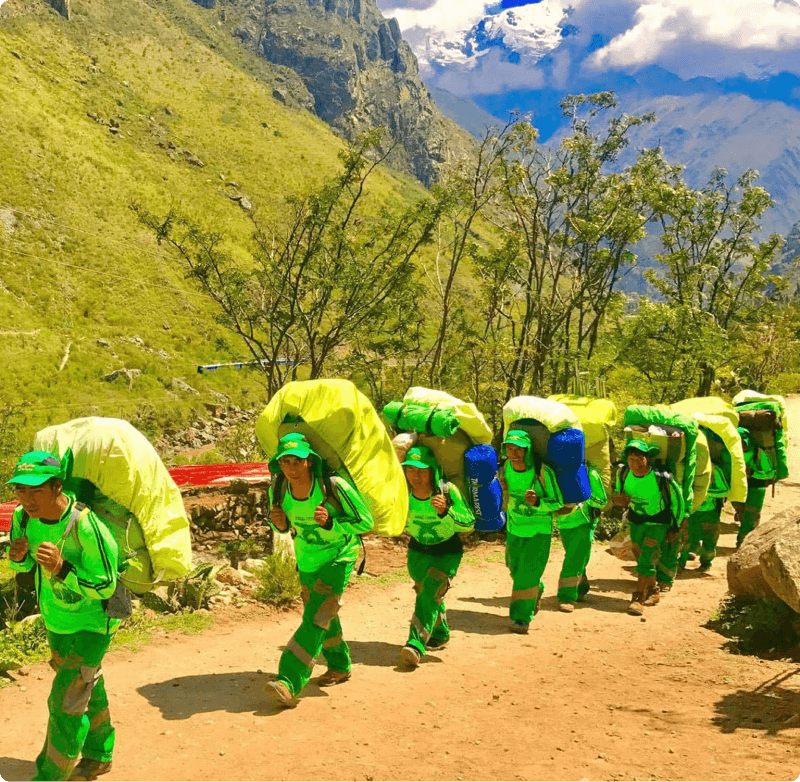 Porters will carry up to 7 kg of your personal items, which must include your sleeping bag and air mat (if you bring or rent one). From us, these two items weigh a combined total of 3.5 kg.